Introduction
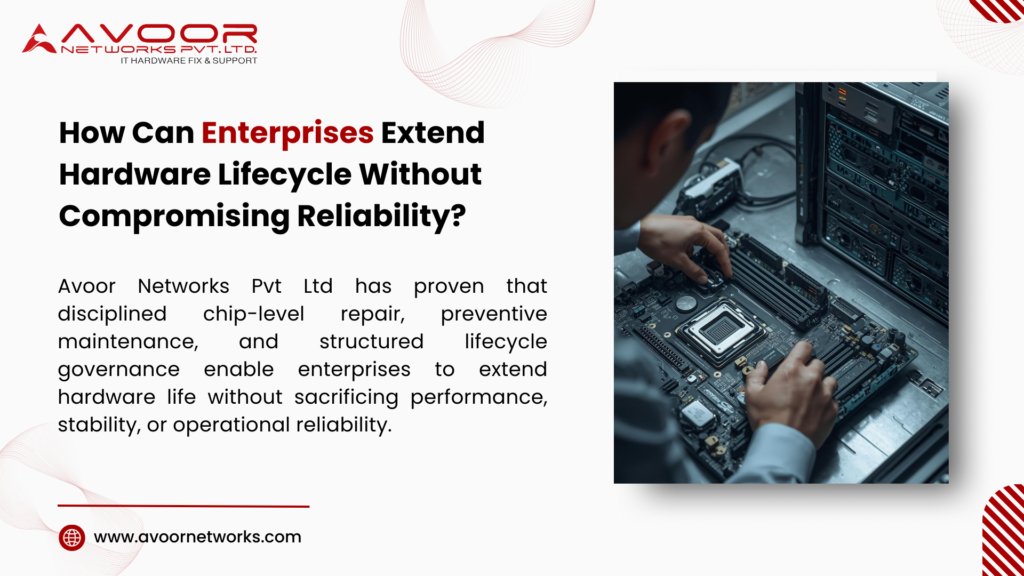
Enterprise hardware lifecycle extension is no longer just a cost-saving tactic—it is a strategic discipline. As technology refresh cycles accelerate and capital budgets tighten, enterprises face mounting pressure to extract greater value from existing infrastructure investments. At the same time, reliability expectations have never been higher. Downtime disrupts revenue, damages reputation, and erodes customer trust.
The perceived tension between lifecycle extension and reliability often leads organizations to prematurely replace hardware. Yet in many enterprise environments, systems are retired not because they are incapable, but because governance, maintenance, and lifecycle planning are insufficiently structured.
Extending hardware lifespan without compromising reliability is possible—but only when approached with discipline.
Enterprise hardware lifecycle extension requires proactive maintenance, structured monitoring, strategic component replacement, and professional support frameworks. When executed correctly, lifecycle extension reduces capital expenditure, enhances financial predictability, and maintains operational resilience.
The real question is not whether hardware can last longer. It is whether governance can support it.
1. Enterprise Hardware Lifecycle Extension Begins with Preventive Maintenance Discipline
Preventive maintenance forms the foundation of enterprise hardware lifecycle extension.
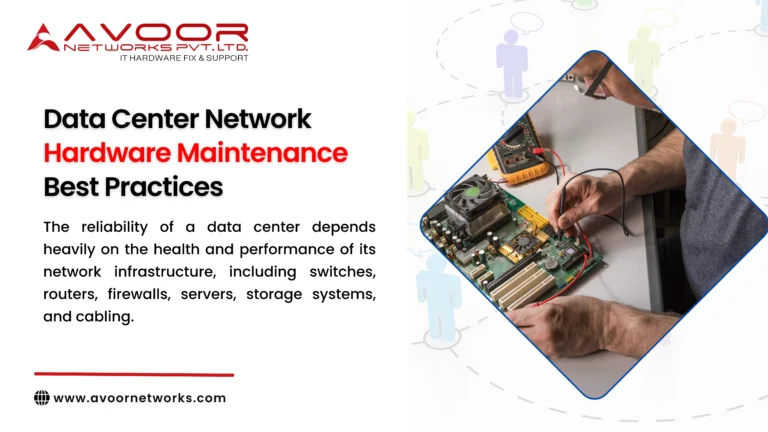
Enterprise-grade networking and server hardware are engineered for durability. However, environmental factors, thermal fluctuations, dust accumulation, and firmware drift can degrade performance over time.
Structured maintenance includes:
- Scheduled hardware inspections
- Thermal and airflow validation
- Firmware updates aligned with compatibility matrices
- Power supply health checks
- Log analysis for early anomaly detection
When preventive maintenance is consistent, minor degradations are corrected before they escalate into failures.
Reliability is preserved not by replacing hardware prematurely, but by maintaining it rigorously.
Organizations that neglect preventive care often misinterpret failure as age-related. In reality, it is maintenance-related.
2. Enterprise Hardware Lifecycle Extension Requires Structured Performance Monitoring
Monitoring is not just for incident detection—it is essential for lifecycle management.
Enterprise hardware lifecycle extension depends on understanding:
- CPU utilization trends
- Memory saturation patterns
- Port error rates
- Packet drop behavior
- Environmental stress indicators
Trend analysis reveals whether hardware performance remains within safe operational thresholds.
If monitoring indicates stable utilization well below capacity, replacement may be unnecessary. Conversely, early signs of strain signal the need for targeted intervention rather than full-scale refresh.
Structured monitoring transforms lifecycle extension from guesswork into data-driven strategy.
3. Strategic Component Replacement Protects Reliability
Not all hardware components age uniformly.
Fans, power supplies, storage drives, and interface modules often degrade faster than chassis or processing units.
Enterprise hardware lifecycle extension leverages selective component replacement:
- Swapping aging power modules
- Replacing degraded SSDs or HDDs
- Upgrading memory modules
- Installing refreshed line cards
This targeted approach restores reliability without requiring complete system replacement.
Selective renewal preserves investment while minimizing disruption.
Strategically replacing vulnerable components maintains performance integrity across extended lifecycle phases.
4. Firmware Governance Is Critical to Enterprise Hardware Lifecycle Extension
Firmware stagnation increases risk.
Outdated firmware may expose vulnerabilities, create compatibility issues, or limit performance optimization.
Enterprise hardware lifecycle extension requires disciplined firmware governance:
- Periodic compatibility validation
- Security patch application
- Vendor advisory review
- Regression testing before deployment
Firmware management ensures hardware operates at optimal efficiency and security posture.
Reliability degradation often stems from software misalignment rather than physical aging.
Lifecycle extension must include software lifecycle management.
5. Enterprise Hardware Lifecycle Extension Depends on Environmental Control
Physical environment significantly influences hardware longevity.
Enterprise hardware lifecycle extension is strengthened by:
- Stable temperature control
- Humidity regulation
- Clean airflow management
- Redundant power conditioning
Overheating accelerates component wear. Dust accumulation impairs cooling efficiency. Power instability damages circuits.
Environmental discipline extends operational lifespan and preserves performance consistency.
Infrastructure longevity begins with facility governance.
6. Third-Party Maintenance Strengthens Enterprise Hardware Lifecycle Extension
OEM support expiration often triggers premature replacement decisions.
However, enterprise hardware lifecycle extension can continue safely through structured third-party maintenance.
Professional maintenance providers offer:
- Hardware diagnostics
- Spare part management
- Component-level repair
- Technical escalation support
- Lifecycle advisory services
Third-party support bridges the gap between OEM lifecycle limits and actual hardware capability.
This ensures aging hardware remains stable and serviceable.
Support structure, not OEM branding, determines reliability sustainability.
7. Capacity Planning Supports Lifecycle Extension
Overloaded systems fail faster.
Enterprise hardware lifecycle extension requires realistic capacity planning:
- Avoiding sustained high utilization
- Maintaining headroom for growth
- Distributing workloads evenly
- Implementing redundancy properly
When systems operate continuously near peak capacity, stress accelerates wear.
Balanced workload distribution preserves hardware health.
Lifecycle extension thrives in environments where utilization is strategically managed rather than maximized recklessly.
8. Documentation and Configuration Control Prevent Hidden Risk
Configuration drift increases instability.
Enterprise hardware lifecycle extension relies on:
- Updated network diagrams
- Change logs
- Asset inventory tracking
- Configuration backups
Without documentation discipline, troubleshooting becomes reactive and time-consuming.
Accurate records reduce recovery time during incidents, preserving reliability.
Lifecycle extension is not simply technical—it is procedural.
Governance protects performance.
9. Risk Assessment and Phased Refresh Planning Ensure Safe Extension
Lifecycle extension must not become stagnation.
Periodic risk assessment ensures hardware remains viable:
- Reviewing failure history
- Evaluating support availability
- Benchmarking performance
- Assessing compatibility with future initiatives
Phased refresh planning allows gradual modernization without abrupt capital shock.
Enterprise hardware lifecycle extension works best when paired with strategic roadmap alignment.
Extension is safe when deliberate, not indefinite.
Financial Advantages of Enterprise Hardware Lifecycle Extension
Extending hardware lifecycle improves capital efficiency.
Benefits include:
- Reduced depreciation pressure
- Lower procurement frequency
- Predictable maintenance budgeting
- Capital reallocation toward innovation
Cost control strengthens competitive positioning.
However, savings must not compromise reliability. Disciplined governance ensures extension does not translate into risk accumulation.
Financial prudence must align with technical prudence.
Strategic Balance Between Extension and Modernization
Enterprise hardware lifecycle extension does not reject modernization.
Instead, it creates breathing room.
Organizations can:
- Plan migrations carefully
- Pilot new technologies gradually
- Avoid forced upgrades
- Align refresh cycles with strategic objectives
This balance stabilizes operational foundations while enabling innovation.
Enterprise Lifecycle Solutions by Avoor Networks Pvt Ltd
Avoor Networks Pvt Ltd supports enterprise hardware lifecycle extension through preventive maintenance, chip-level repair, structured AMC programs, and EOL/EOSL infrastructure support.
With over 26+ years of experience, the company provides:
- Router, switch, and server maintenance
- Component-level repair and replacement
- Preventive inspection and diagnostics
- AMC and CAMC services
- Pan-India technical support
This ensures lifecycle extension is executed with reliability discipline.
Conclusion
Enterprise hardware lifecycle extension is not about delaying inevitable replacement—it is about maximizing asset value without sacrificing reliability.
Through preventive maintenance, structured monitoring, environmental governance, component replacement, firmware discipline, and professional support, enterprises can safely extend hardware lifespan.
Reliability is preserved when extension is governed strategically.
In mature enterprise environments, lifecycle extension becomes a financial advantage, operational stabilizer, and strategic enabler.
Hardware longevity is not a compromise.
It is a managed outcome of disciplined infrastructure governance.