Introduction
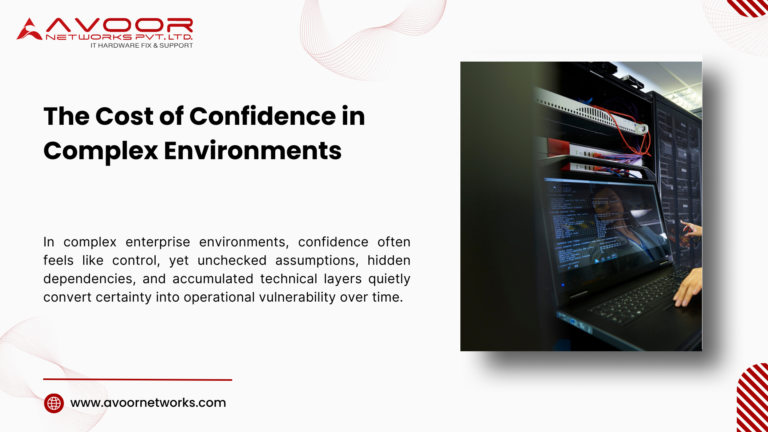
Complex environment risk grows gradually inside high-performance organizations. It rarely appears during stable operations, successful deployments, or steady revenue cycles. Instead, complex environment risk accumulates when confidence begins to replace disciplined review, architectural scrutiny, and structured governance.
Enterprise environments today are not simple systems. They consist of layered networks, hybrid infrastructure, distributed applications, third-party integrations, and evolving security frameworks. Every new layer introduces dependency. Every dependency increases exposure.
Confidence is not inherently dangerous. In fact, it fuels growth and strategic execution. However, when confidence is not continuously validated, complex environment expands silently beneath operational stability.
Organizations that understand this dynamic sustain resilience. Those that equate stability with invulnerability eventually discover that confidence without discipline has a cost.
1. How Complex Environment Risk Develops During Stable Periods
Complex environment does not grow during crisis alone. It often expands during calm.
When systems operate without visible disruption:
- Governance meetings shorten
- Audit frequency declines
- Preventive maintenance schedules compress
- Architectural reviews become routine rather than rigorous
Leadership interprets stability as proof of strength. Yet complex systems may appear stable simply because they have not yet been stressed beyond hidden thresholds.
Dependency chains grow. Configuration drift accumulates. Minor inefficiencies compound.
The danger lies in assuming that stability proves structural robustness. In reality, complex environment risk may be increasing precisely because scrutiny decreases during calm periods.
2. Complex Environment Risk and Accumulated Architectural Layers
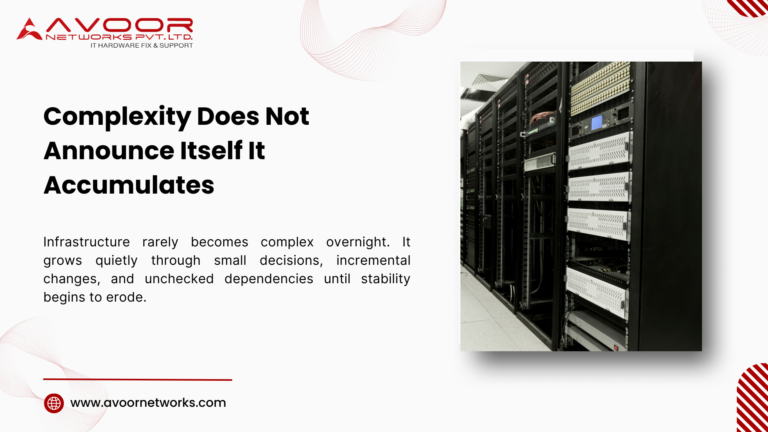
As organizations grow, they add systems rather than remove them.
New monitoring tools coexist with old ones. Cloud platforms integrate with legacy hardware. Security controls overlap across environments. Custom scripts compensate for design limitations.
Each layer appears justified. Collectively, they produce architectural opacity.
It increases when:
- Interdependencies are poorly mapped
- Documentation trails behind implementation
- Ownership boundaries blur
In highly layered environments, root cause analysis becomes slower. Failure propagation becomes less predictable.
Architectural discipline must include simplification, not just expansion. Without periodic reduction of unnecessary complexity, it compounds with every integration decision.
3. Complex Environment Risk and the Illusion of Control
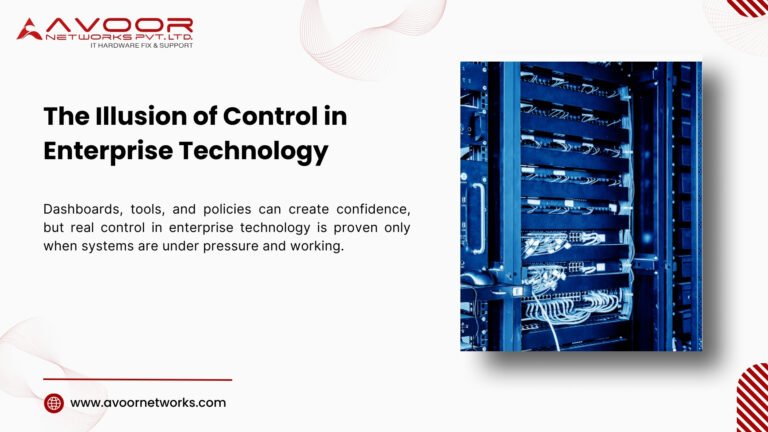
Modern dashboards create confidence.
Metrics display uptime percentages, latency averages, and utilization levels. Executives review performance summaries and interpret green indicators as confirmation of control.
Yet it persists even when metrics appear healthy.
Dashboards operate within defined parameters. If those parameters fail to account for inter-system dependencies or evolving thresholds, early warning signs may remain invisible.
Control requires more than observation. It requires interpretation, validation, and corrective discipline.
When organizations rely solely on monitoring visibility, complex environment risk becomes masked by perceived transparency.
4. Why Ignoring Minor Incidents Increases Complex Environment Risk
Small disruptions provide insight into structural weakness.
A brief service interruption. A misconfigured firewall rule. A temporary performance degradation. These incidents often resolve quickly.
Confidence grows because recovery is rapid.
However, repeated minor events signal emerging stress.
Complex environment risk expands when:
- Recurring patterns are dismissed
- Root cause analysis is superficial
- Preventive remediation is delayed
In complex systems, small anomalies frequently precede major failures. Treating minor incidents as routine reduces opportunity for early correction.
Organizations that treat every incident as strategic intelligence reduce long-term exposure.
5. Scaling Without Review Amplifies Complex Environment Risk
Growth introduces strain.
Expanding workloads, onboarding new clients, integrating acquisitions, or migrating services to hybrid cloud models increases systemic load.
If architectural assumptions remain unchanged during scaling, complex environment risk intensifies.
Legacy performance thresholds may no longer apply. Redundancy designs may not match increased transaction volume. Security configurations may struggle with expanded attack surfaces.
Confidence derived from previous scaling success can suppress reassessment.
Organizations must revisit architecture proportionally to growth. Otherwise, complex environment risk scales alongside expansion.
6. Deferred Governance and Complex Environment Risk
Governance is easiest to neglect when operations appear smooth.
Documentation updates feel unnecessary. Compliance reviews seem redundant. Technical debt appears manageable.
Yet deferred governance directly increases complex environment risk.
Configuration inconsistencies multiply. Support contracts lapse. Lifecycle planning stagnates. Security patch cycles extend.
When governance weakens, risk accumulation accelerates.
Effective organizations maintain governance intensity even during calm cycles. They understand that oversight during stability prevents crisis during stress.
7. Leadership Overconfidence and Complex Environment Risk
Leadership tone influences operational behavior.
When executives express high confidence in system resilience without demanding validation, teams may hesitate to escalate concerns.
Complex environment risk thrives in environments where dissent is minimized and success narratives dominate discussion.
Disciplined leadership encourages:
- Independent audits
- Transparent reporting
- Critical peer review
- Stress testing exercises
Confidence becomes productive only when paired with structured skepticism.
Overconfidence reduces vigilance. Reduced vigilance increases exposure.
Financial and Strategic Implications
The cost of complex environment risk extends beyond technical disruption.
Financial impact includes:
- Emergency remediation expenses
- Revenue loss during downtime
- Increased regulatory scrutiny
- Reputation damage
Strategically, elevated risk limits agility. Organizations become hesitant to pursue transformation initiatives if infrastructure confidence is untested.
Preventive discipline stabilizes cost structures. It converts unpredictable crisis spending into manageable operational planning.
Managing Complex Environment Risk Through Discipline
Reducing complex environment risk requires intentional action:
- Conduct recurring architectural reviews
- Consolidate redundant tools
- Map system dependencies comprehensively
- Treat minor incidents as leading indicators
- Maintain strict lifecycle governance
- Encourage leadership humility
Complex systems demand continuous evaluation. Resilience is not achieved once; it is reinforced repeatedly.
Confidence becomes sustainable when supported by evidence, documentation, and proactive oversight.
Conclusion
Complex environment risk is not created by technology alone. It emerges when confidence outpaces governance, when growth outpaces reassessment, and when stability is mistaken for structural strength.
In layered enterprise ecosystems, exposure accumulates gradually. Minor oversights compound. Deferred reviews amplify dependency opacity. Overconfidence suppresses vigilance.
Organizations that sustain resilience do not eliminate confidence—they discipline it. They validate assumptions, stress-test systems, and maintain governance intensity regardless of recent success.
Complex environment risk is inevitable in large-scale systems. Unmanaged complex environment risk is optional.
Resilient enterprises choose discipline over assumption.