Introduction
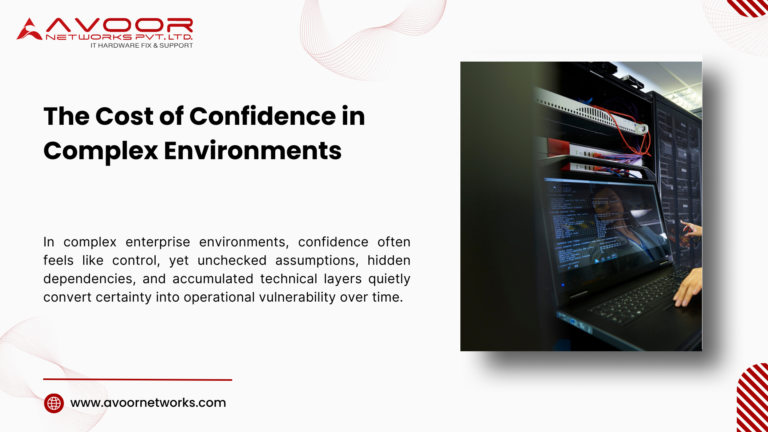
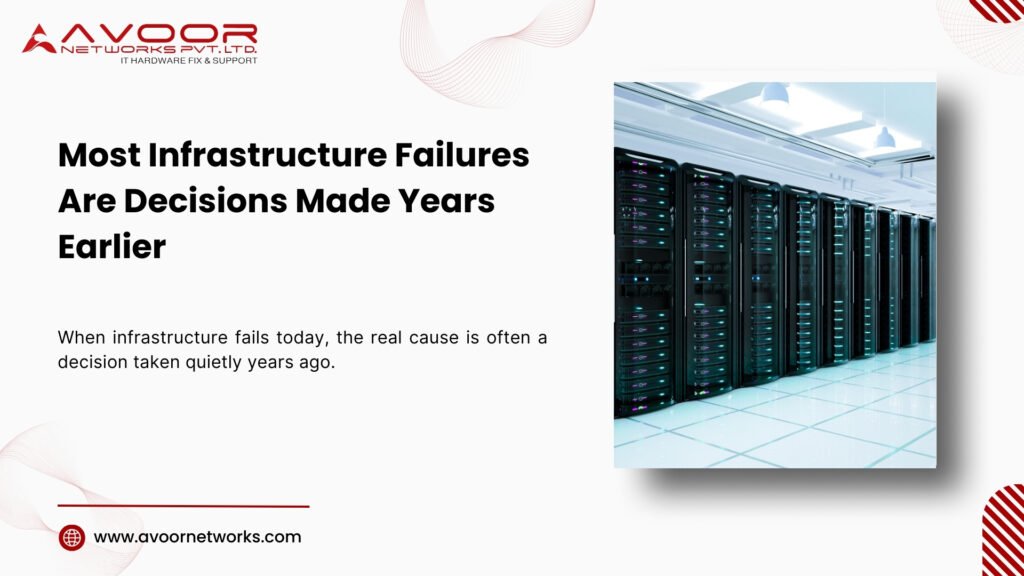
Infrastructure failures rarely happen overnight. When a critical network, server, or data center component fails unexpectedly, it is often labeled as a sudden incident. In reality, most infrastructure failures are the result of decisions made years earlier.
Enterprise IT environments are built over time through design choices, budget approvals, maintenance practices, and upgrade strategies. When reliability issues surface, they usually trace back to early compromises that seemed harmless at the time.
Understanding how long-term decisions shape infrastructure outcomes helps enterprises prevent failures rather than react to them.
1. Ignoring Capacity Planning in Early Stages
One of the earliest contributors to infrastructure failures is poor capacity planning.
Common mistakes include:
- Designing infrastructure only for current workloads
- Underestimating future growth
- Ignoring redundancy requirements
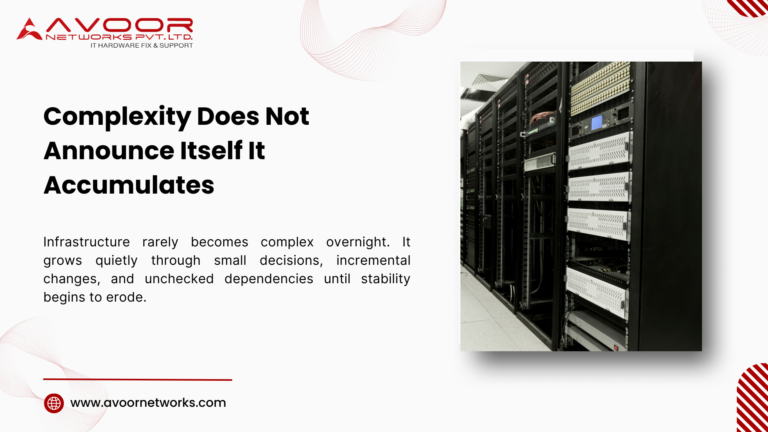
When systems are consistently pushed beyond their limits, components degrade faster. Years later, these early capacity decisions manifest as instability, bottlenecks, and eventual failure.
2. Choosing Cost Over Reliability
Cost-driven decisions often create hidden risk.
Early choices such as:
- Selecting lower-grade hardware
- Reducing redundancy to save budget
- Skipping environmental controls
may appear financially responsible. Over time, however, these decisions increase failure probability. Infrastructure failures caused by cost compromises often result in higher long-term expenses than the original savings.
3. Delaying Preventive Maintenance
Preventive maintenance is frequently postponed because systems appear to be working.
This decision leads to:
- Dust buildup
- Fan and power supply degradation
- Undetected warning signs
Years later, failures occur suddenly, even though the root cause was neglect. Delayed maintenance is one of the most common long-term contributors to infrastructure failures.
4. Allowing Infrastructure to Age Without Strategy
Infrastructure does not become risky the moment it reaches end-of-life. Risk grows when aging hardware is left unmanaged.
Without a strategy:
- Failure patterns become unpredictable
- Spare parts become difficult to source
- Recovery times increase
Infrastructure failures in aging environments are rarely isolated incidents. They are the cumulative result of years without structured lifecycle planning.
5. Treating Reliability as a Feature
Many organizations assume reliability is something purchased with better hardware.
This belief leads to:
- Overreliance on vendors
- Underinvestment in processes
- Lack of operational discipline
Reliability is not a feature. It is an outcome of consistent execution. Infrastructure failures occur when organizations fail to treat reliability as an operating discipline from the beginning.
6. Postponing Hardware Refresh Decisions
Delaying refresh decisions is often seen as cost control.
However, postponement without risk evaluation:
- Increases downtime probability
- Forces emergency replacements
- Disrupts budget planning
Infrastructure failures triggered by delayed refreshes are usually more expensive and disruptive than planned upgrades executed earlier.
7. Operating Without Professional Lifecycle Support
The absence of professional support is a long-term decision with serious consequences.
Without lifecycle support:
- Failures take longer to diagnose
- Repairs are delayed
- Recovery depends on OEM timelines
Many infrastructure failures escalate simply because expert support was not in place when issues first appeared.
Preventing Infrastructure Failures Through Early Discipline
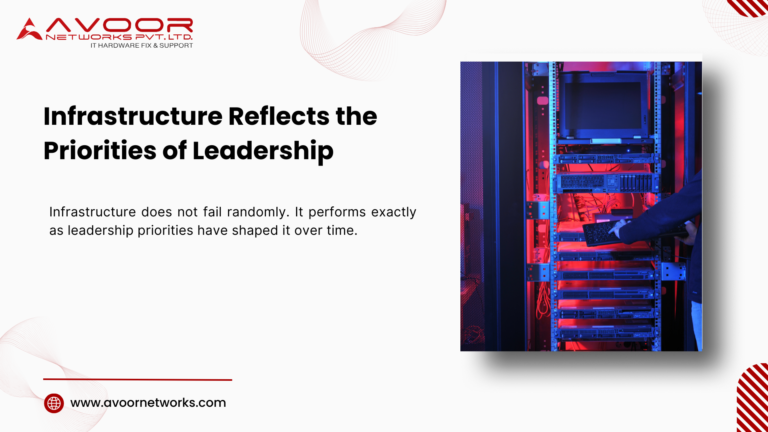
The common theme behind infrastructure failures is not technology. It is decision-making.
Enterprises that succeed:
- Plan capacity early
- Invest in maintenance discipline
- Evaluate aging risk continuously
- Partner with professional support providers
These decisions, made early and consistently, prevent failures years later.
Enterprise Infrastructure Support by Avoor Networks Pvt Ltd
Avoor Networks Pvt Ltd helps enterprises reduce infrastructure failures by addressing risks at every stage of the lifecycle.
With 26+ years of experience, the company provides:
- Enterprise router, switch, and server support
- Preventive and corrective maintenance
- Chip-level hardware repair
- AMC and CAMC services
- Support for EOL and EOSL infrastructure
- Pan-India on-site and remote assistance
This lifecycle-driven approach helps enterprises correct earlier decisions before they turn into failures.
Conclusion
Infrastructure failures are rarely sudden or unavoidable. They are usually the delayed result of decisions made years earlier during planning, budgeting, maintenance, and support selection.
Enterprises that recognize this pattern gain the ability to change outcomes. By treating infrastructure reliability as a long-term discipline rather than a short-term expense, organizations can reduce downtime, control costs, and maintain operational stability.
The best time to prevent infrastructure failures is not during an outage. It is years before one happens.