Introduction
Infrastructure maturity is often overlooked in enterprise IT strategy. Organizations invest heavily in modernization initiatives—new platforms, faster hardware, cloud migrations—believing newer technology automatically delivers stability and performance.
In reality, many modernized environments fail more often than older ones. The reason is simple: modernization improves capability, but maturity determines reliability. Without mature processes, skilled operations, and lifecycle discipline, even the most advanced infrastructure becomes fragile.
Understanding why infrastructure maturity matters more than modernization is essential for enterprises that want predictable uptime, controlled risk, and long-term operational stability.
1. Maturity Determines How Systems Behave Under Stress
Infrastructure maturity defines how systems respond when things go wrong.
In mature environments:
- Failures are anticipated
- Recovery steps are documented
- Teams respond predictably
In immature environments, stress exposes gaps immediately. Systems may be modern and powerful, but outages escalate quickly due to lack of preparedness. Infrastructure maturity ensures stability under pressure, not just performance during normal operation.
2. Modernization Without Maturity Increases Risk
Modernization without maturity often introduces instability.
This happens when:
- New technology is deployed without process changes
- Teams lack operational experience
- Support models are undefined
Modern systems amplify both strengths and weaknesses. Without maturity, modernization increases complexity faster than an organization’s ability to manage it, raising failure risk instead of reducing it.
3. Operational Discipline Outlasts New Technology
Technology evolves quickly. Operational discipline does not become obsolete.
Infrastructure maturity is built through:
- Standardized processes
- Clear ownership
- Preventive maintenance
- Controlled change management
While tools change every few years, disciplined operations remain effective across generations of technology. This is why mature infrastructure consistently outperforms newer but unmanaged environments.
4. Maturity Reduces Downtime More Than Upgrades
Downtime is rarely caused by outdated technology alone.
More often, it is caused by:
- Missed warning signs
- Slow response
- Unclear escalation paths
Infrastructure maturity addresses these issues directly. Monitoring, maintenance, and response discipline prevent outages more effectively than replacing hardware or platforms prematurely.
5. Mature Infrastructure Ages Predictably
All infrastructure ages. Mature infrastructure ages safely.
In mature environments:
- Hardware condition is monitored
- Risks are assessed continuously
- Failures are anticipated, not surprising
Immature environments experience sudden, disruptive failures because aging is unmanaged. Infrastructure maturity turns aging into a planned process rather than a crisis.
6. Decision Quality Improves With Infrastructure Maturity
Maturity improves how decisions are made.
With infrastructure maturity:
- Repair vs replacement decisions are informed
- Modernization is timed strategically
- Budget planning becomes predictable
Instead of reacting during outages, mature organizations make decisions calmly, based on data and lifecycle understanding.
7. Maturity Enables Smarter Modernization
Infrastructure maturity does not oppose modernization. It enables it.
When maturity exists:
- Modernization is phased
- Risk is controlled
- Benefits are realized faster
Enterprises with mature infrastructure modernize successfully because they understand their environment deeply. Those without maturity struggle, regardless of how advanced the technology is.
Closing the Maturity vs Modernization Gap
Modernization improves what systems can do. Infrastructure maturity determines what systems actually deliver in production.
Enterprises that prioritize maturity build stable foundations that support modernization safely. Those that chase modernization without maturity often repeat cycles of disruption, cost overruns, and instability.
Enterprise Infrastructure Maturity Support by Avoor Networks Pvt Ltd
Avoor Networks Pvt Ltd helps enterprises build infrastructure maturity before, during, and after modernization initiatives.
With 26+ years of experience, the company provides:
- Enterprise router, switch, and server support
- Preventive and corrective maintenance
- Chip-level hardware repair
- AMC and CAMC services
- Support for EOL and EOSL infrastructure
- Pan-India on-site and remote assistance
This lifecycle-driven approach ensures modernization is built on stable, mature foundations.
Conclusion
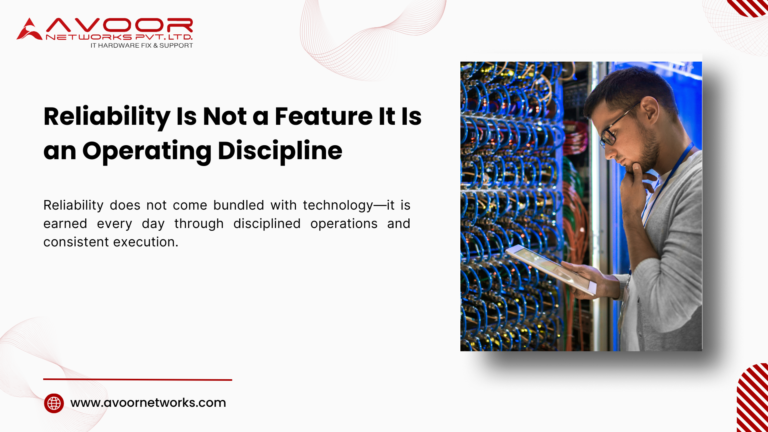
Infrastructure maturity matters more than modernization because reliability is not created by new technology alone. It is created by disciplined operations, informed decisions, and lifecycle awareness.
Enterprises that invest in maturity gain predictable uptime, controlled risk, and smoother modernization outcomes. In contrast, those that prioritize modernization without maturity often inherit faster failures instead of better performance.
In enterprise IT, maturity is the force multiplier that makes modernization successful.