Introduction
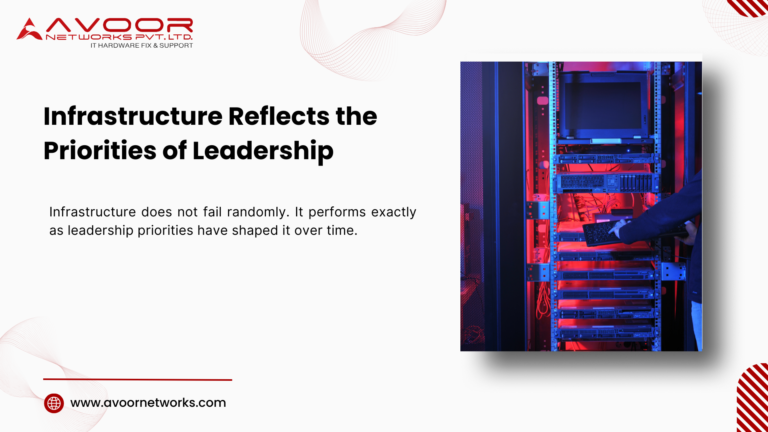
Leadership infrastructure priorities are visible in the stability, resilience, and maturity of enterprise IT environments. Infrastructure does not accidentally become reliable or fragile. It becomes what leadership chooses to emphasize, fund, and protect.
Servers, networks, data centers, and support systems reflect executive decisions made over years. When leadership prioritizes growth without governance, modernization without maturity, or cost savings without resilience, infrastructure mirrors those values.
Understanding how infrastructure reflects leadership priorities is essential for enterprises that want long-term operational strength instead of short-term performance gains.
1. Budget Allocation Reveals True Priorities
Leadership priorities are most clearly reflected in budget decisions.
When budgets consistently favor:
- New initiatives over maintenance
- Expansion over stabilization
- Cost reduction over redundancy
infrastructure stability eventually weakens.
Operational strength requires balanced investment. Enterprises that allocate resources to preventive maintenance, support contracts, monitoring systems, and lifecycle planning demonstrate that resilience is a strategic priority—not an afterthought.
2. Maintenance vs Modernization Decisions
Modernization is often more visible and politically attractive than maintenance.
Leadership that prioritizes modernization alone may:
- Upgrade platforms rapidly
- Adopt new technologies frequently
- Overlook operational readiness
Meanwhile, routine maintenance may be underfunded.
Infrastructure reliability reflects whether leadership values operational discipline as much as innovation. Mature environments are built by leaders who understand that modernization without stability increases risk.
3. Tolerance for Technical Debt
Technical debt accumulates when short-term decisions override long-term planning.
Leadership infrastructure priorities become visible when:
- Temporary fixes become permanent
- Documentation is delayed
- Known issues remain unresolved
Over time, accumulated technical debt increases fragility. Organizations that tolerate debt implicitly accept future instability. Those that actively reduce it build stronger, more predictable systems.
4. Investment in Operational Discipline
Operational discipline includes structured processes, change management, monitoring, and governance.
When leadership supports:
- Clear accountability
- Defined escalation procedures
- Standardized deployment practices
infrastructure becomes stable and predictable.
If discipline is viewed as bureaucracy rather than protection, instability increases. Infrastructure reflects whether leadership respects process maturity.
5. Approach to Risk and Redundancy
Redundancy is a leadership decision, not a technical accident.
Choosing whether to:
- Implement failover systems
- Maintain backup environments
- Invest in disaster recovery
reveals how leadership evaluates risk.
Organizations that accept single points of failure often do so to reduce cost. However, when failure occurs, the absence of redundancy exposes leadership priorities immediately.
6. Response to Early Warning Signs
Every infrastructure environment produces early signals before major failures occur.
Leadership infrastructure priorities are revealed in how these signals are handled:
- Are risks escalated quickly?
- Are proactive fixes funded?
- Is monitoring data reviewed strategically?
Ignoring early warnings sends a message that stability is secondary. Acting on them builds resilience.
7. Long-Term Lifecycle Governance
Lifecycle governance determines whether infrastructure evolves predictably.
Strong leadership ensures:
- Hardware refresh cycles are planned
- End-of-life risk is managed
- Support models are maintained
Without lifecycle planning, infrastructure ages into crisis. With governance, aging becomes manageable and controlled.
The Cultural Impact of Leadership Decisions
Infrastructure stability is not just technical. It is cultural.
When leadership consistently emphasizes reliability, accountability, and preparedness, those values shape operational behavior. Teams adopt discipline because it is supported and expected.
Conversely, when speed, cost cutting, or rapid expansion override governance, instability becomes normalized. Infrastructure mirrors leadership culture over time.
Enterprise Infrastructure Support by Avoor Networks Pvt Ltd
Avoor Networks Pvt Ltd supports enterprises in aligning leadership infrastructure priorities with long-term operational strength.
With 26+ years of experience, the company provides:
- Enterprise router, switch, and server support
- Preventive and corrective maintenance
- Chip-level hardware repair
- AMC and CAMC contracts
- EOL and EOSL infrastructure support
- Pan-India service coverage
This structured approach helps leadership translate strategic intent into reliable infrastructure outcomes.
Conclusion
Infrastructure reflects leadership priorities more accurately than strategy documents. Budgets, governance decisions, maintenance discipline, and lifecycle planning shape how stable or fragile systems become.
Enterprises that prioritize resilience, accountability, and proactive management build infrastructure capable of supporting long-term growth. Those that emphasize short-term gains at the expense of governance eventually experience instability.
In enterprise IT, infrastructure is not just technology. It is a mirror of leadership values.