Introduction
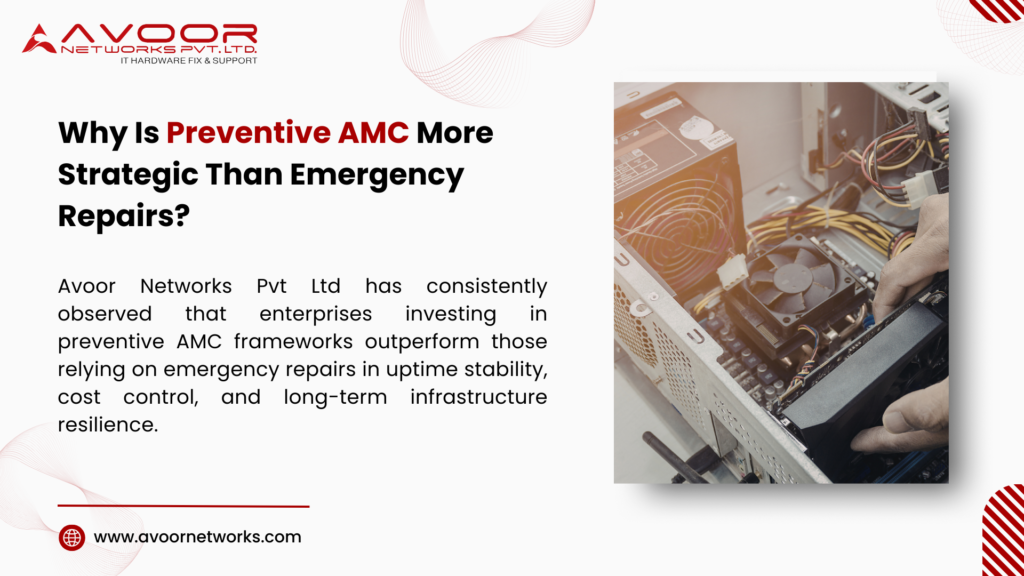
Preventive AMC strategy is often misunderstood as a routine maintenance arrangement rather than a strategic decision. Many organizations treat Annual Maintenance Contracts as operational overhead, something required to keep systems running. Emergency repairs, on the other hand, are viewed as inevitable responses to unpredictable failures.
This mindset creates long-term exposure.
In enterprise environments where infrastructure supports revenue generation, compliance obligations, and customer trust, downtime is not merely an inconvenience—it is financial and reputational risk. A preventive AMC strategy shifts maintenance from reactive repair to proactive stability management. It converts unpredictable disruption into structured lifecycle governance.
Emergency repairs solve immediate problems. Preventive AMC builds structural resilience.
Organizations that recognize this difference move from firefighting mode to strategic control.
1. Preventive AMC Strategy Reduces Unpredictable Downtime
Unplanned downtime is one of the most expensive operational risks in enterprise IT.
Emergency repairs typically occur after:
- Hardware failure
- Performance collapse
- Power instability
- Component burnout
- Firmware corruption
By the time emergency support is activated, business impact has already begun.
A preventive AMC strategy minimizes these scenarios by identifying vulnerabilities early. Routine inspections, health diagnostics, firmware validation, and performance checks reduce the probability of sudden breakdown.
Instead of reacting to outages, organizations prevent them.
The strategic difference is timing. Emergency repair is reactive. Preventive AMC is anticipatory.
In high-performance organizations, anticipation protects revenue and credibility.
2. Preventive AMC Strategy Stabilizes Financial Planning
Emergency repairs disrupt budgets.
Unexpected hardware replacement, urgent procurement, expedited shipping, and after-hours engineering support create financial volatility. Leadership teams are forced to reallocate funds during crises.
A preventive AMC strategy transforms this unpredictability into controlled cost planning.
With structured maintenance agreements:
- Service costs are predefined
- Inspection schedules are fixed
- Replacement cycles are anticipated
- Spare part management is planned
This predictability strengthens financial governance.
Stable cost structures allow organizations to allocate capital toward growth initiatives rather than crisis recovery.
Financial discipline is a strategic advantage. Preventive maintenance supports it directly.
3. Preventive AMC Strategy Extends Infrastructure Lifespan
Enterprise hardware investments are substantial. Routers, switches, servers, storage arrays, and security appliances represent significant capital expenditure.
Emergency repair culture shortens asset lifespan because:
- Maintenance is inconsistent
- Components degrade unnoticed
- Firmware updates are irregular
- Environmental factors are ignored
A preventive AMC strategy extends hardware longevity through structured care.
Regular calibration, cleaning, temperature monitoring, and performance benchmarking prevent premature deterioration.
Extending asset life reduces replacement frequency and capital expenditure strain.
From a strategic perspective, lifecycle optimization enhances return on infrastructure investment.
4. Preventive AMC Strategy Protects Brand Reputation
Customers may tolerate innovation delays. They rarely tolerate instability.
When systems fail unexpectedly:
- Service-level agreements are breached
- Client trust erodes
- Social media criticism escalates
- Regulatory attention increases
Emergency repairs restore functionality—but reputation damage may persist.
A preventive AMC strategy protects public perception by minimizing visible disruption.
Organizations known for consistent uptime build credibility. Credibility converts into client loyalty and competitive differentiation.
Reliability becomes part of brand identity.
In enterprise markets, reputation is an asset. Preventive maintenance protects that asset.
5. Preventive AMC Strategy Improves Operational Discipline
Reactive environments foster chaotic work patterns.
When teams operate primarily in emergency mode:
- Long-term planning declines
- Documentation lags
- Technical debt accumulates
- Stress increases
A preventive AMC strategy introduces structured operational rhythm.
Scheduled inspections, defined escalation procedures, performance baselines, and regular reporting create operational predictability.
Teams shift from reactive troubleshooting to proactive optimization.
Discipline enhances clarity. Clarity enhances execution.
Strategically, operational maturity increases organizational agility.
6. Preventive AMC Strategy Reduces Risk in End-of-Life Infrastructure
Many enterprises operate hardware beyond OEM support cycles due to budget constraints or phased upgrade plans.
Emergency repair approaches expose such infrastructure to severe risk.
When unsupported hardware fails without preventive oversight, recovery becomes complex and costly.
A preventive AMC strategy provides:
- Structured support beyond OEM lifecycle
- Spare part management
- Risk evaluation
- Controlled migration planning
This ensures aging infrastructure remains stable until strategic replacement occurs.
Lifecycle control reduces exposure during transitional periods.
7. Preventive AMC Strategy Enables Strategic Focus
Organizations consumed by emergency repair cycles devote leadership energy to crisis management rather than growth.
Frequent outages disrupt strategic initiatives:
- Digital transformation slows
- Expansion plans are postponed
- Innovation pipelines stall
A preventive AMC strategy stabilizes infrastructure, freeing leadership bandwidth.
When operational foundations are reliable, strategic initiatives accelerate.
Reliability becomes growth enabler rather than maintenance burden.
The true strategic value of preventive maintenance lies in what it enables—not just what it prevents.
Emergency Repairs: Necessary but Not Strategic
Emergency repairs are essential when failure occurs. However, they are tactical responses, not strategic frameworks.
Relying solely on emergency repairs creates:
- Unpredictable downtime
- Financial volatility
- Increased stress
- Reduced infrastructure lifespan
- Reputational exposure
Emergency repair culture keeps organizations in reactive posture.
Preventive AMC shifts posture to proactive governance.
Preventive AMC Strategy as Competitive Differentiator
In competitive industries, operational stability differentiates providers.
Organizations with preventive maintenance discipline:
- Deliver consistent service
- Meet contractual commitments reliably
- Scale without fear of collapse
- Earn regulatory trust
Competitors operating reactively struggle with recurring disruption.
Preventive AMC becomes invisible competitive leverage.
Customers may not see the maintenance—but they experience its benefits.
The Long-Term Strategic Impact
Over time, preventive AMC strategy compounds advantage.
Reduced downtime strengthens trust.
Predictable cost improves financial planning.
Extended hardware lifespan optimizes capital allocation.
Lower stress improves employee retention.
These cumulative effects elevate organizational maturity.
Preventive discipline creates sustainable growth environment.
Enterprise AMC Execution by Avoor Networks Pvt Ltd
Avoor Networks Pvt Ltd delivers structured preventive AMC strategy designed for enterprise environments.
With over 26+ years of experience, services include:
- Router, switch, and server maintenance
- Preventive inspection and diagnostics
- Chip-level hardware repair
- AMC and CAMC programs
- End-of-life and EOSL infrastructure support
- Pan-India on-site and remote service
This proactive approach ensures infrastructure stability before failures occur.
Conclusion
Preventive AMC strategy is not merely maintenance it is strategic governance.
Emergency repairs solve immediate problems but do not reduce systemic exposure. Preventive maintenance reduces downtime, stabilizes financial planning, extends asset lifespan, and protects brand reputation.
Organizations that adopt preventive AMC strategy move from reactive crisis response to disciplined operational control.
In enterprise IT, strategy is not defined only by expansion plans and digital transformation initiatives.
It is defined by how well foundational systems are protected.
Preventive AMC is not cost overhead.
It is competitive infrastructure strategy.