Introduction
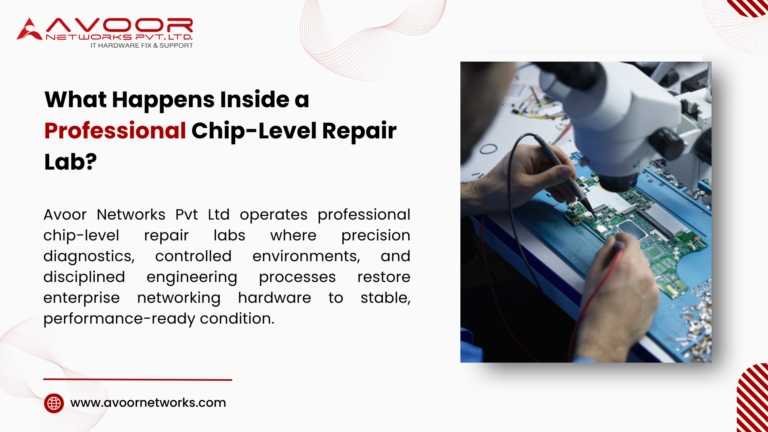
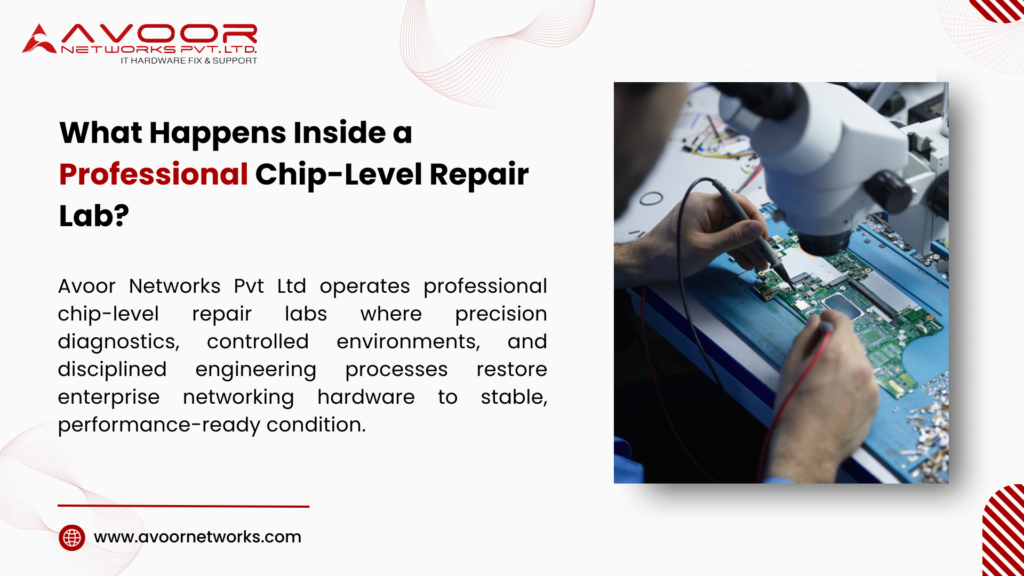
Professional chip-level repair lab operations represent the highest technical tier of enterprise hardware recovery. While many organizations rely on board-level replacements or complete unit swaps, chip-level repair environments work at the microscopic foundation of networking and server hardware. These labs diagnose, isolate, and repair individual electronic components on complex circuit boards.
Enterprise networking equipment—routers, switches, firewalls, and servers—contain multilayer printed circuit boards (PCBs), microprocessors, ASICs, voltage regulators, capacitors, memory modules, and delicate surface-mounted devices (SMDs). When these components fail, replacing the entire unit is often costly and unnecessary.
A professional repair lab restores functionality by identifying the exact failed component and repairing it precisely. This process demands advanced equipment, skilled technicians, controlled environments, and rigorous validation procedures.
Understanding what happens inside a professional repair lab reveals why chip-level repair is both a technical discipline and a strategic advantage in enterprise infrastructure management.
1. Initial Diagnostics Inside a Professional Chip-Level Repair Lab
Every repair begins with structured diagnostics.
Inside a professional chip-level repair lab, technicians first conduct:
- Visual inspection under magnification
- PCB trace examination
- Burn mark identification
- Connector and solder joint assessment
Next, advanced diagnostic tools are used:
- Digital multimeters
- Oscilloscopes
- Logic analyzers
- Thermal imaging cameras
- Power supply testers
The goal is to isolate whether the fault lies in:
- Power regulation circuits
- Data bus lines
- Memory modules
- ASIC chips
- Voltage converters
- Capacitors or resistors
Precise fault isolation is critical. Without accurate diagnosis, unnecessary component replacement increases risk.
A professional chip-level repair lab prioritizes systematic troubleshooting before intervention.
2. Controlled Environment Standards in a Professional Chip-Level Repair Lab
Chip-level repair requires strict environmental discipline.
Inside a professional chip-level repair lab, Electrostatic Discharge (ESD) control is mandatory. Sensitive chips can be damaged by minimal static electricity.
Environmental controls include:
- ESD-safe flooring
- Grounded wrist straps
- Anti-static mats
- Humidity control systems
- Dust-free workspaces
Temperature stability ensures solder integrity and component safety.
Even minor environmental fluctuations can compromise delicate semiconductor handling.
A professional chip-level repair lab maintains controlled conditions to preserve precision and prevent secondary damage.
3. Advanced Micro-Soldering Techniques Used in a Professional Chip-Level Repair Lab
Micro-soldering is at the core of chip-level repair.
Inside a professional chip-level repair lab, technicians use:
- Hot air rework stations
- Infrared BGA rework machines
- Precision soldering irons
- Flux management systems
- Micro-tweezers and microscopes
For Ball Grid Array (BGA) components, specialized reballing processes are performed. This involves removing defective solder balls and applying new ones before reseating the chip.
Micro-soldering requires steady hands, magnified visibility, and controlled heat application.
Improper solder temperature can:
- Warp the PCB
- Damage adjacent components
- Create cold solder joints
A professional chip-level repair lab applies calibrated heat profiles and time control to ensure structural integrity.
4. Component-Level Replacement Processes in a Professional Chip-Level Repair Lab
After isolating the failed component, replacement begins.
Components replaced may include:
- MOSFETs
- Capacitors
- Voltage regulators
- Integrated circuits
- Clock generators
- Memory chips
Each replacement requires:
- Removal of faulty component
- Cleaning of solder pads
- Inspection of PCB traces
- Placement of new component
- Precision soldering
Component sourcing is equally important. A professional chip-level repair lab uses verified components compatible with enterprise-grade equipment.
Substandard parts introduce instability.
Quality control in sourcing directly impacts reliability.
5. Firmware and BIOS Reprogramming Inside a Professional Chip-Level Repair Lab
Not all failures are purely hardware.
Some networking equipment issues involve corrupted firmware, BIOS failure, or flash memory damage.
A professional chip-level repair lab includes:
- EEPROM programmers
- BIOS flashing tools
- Firmware recovery stations
Technicians reprogram corrupted chips or replace flash memory modules.
This step ensures restored hardware operates within vendor-compatible firmware standards.
Hardware without proper firmware validation remains unstable.
Integrated software validation completes the repair process.
6. Burn-In Testing and Stress Validation in a Professional Chip-Level Repair Lab
Repair is incomplete without validation.
Inside a professional chip-level repair lab, repaired units undergo burn-in testing.
This includes:
- Continuous power cycling
- Load simulation
- Network traffic simulation
- Thermal stress testing
- Voltage stability monitoring
Burn-in cycles may run for 24–72 hours depending on device complexity.
Stress testing ensures:
- No intermittent failures
- Stable power delivery
- Consistent processing performance
This stage transforms repair into reliability assurance.
Professional labs never return equipment without structured validation.
7. Documentation and Quality Assurance in a Professional Chip-Level Repair Lab
Enterprise clients require accountability.
A professional chip-level repair lab maintains detailed documentation including:
- Fault diagnosis reports
- Replaced component logs
- Test results
- Serial tracking
- Warranty documentation
Quality assurance teams verify repair consistency and compliance.
Documentation provides transparency and traceability.
Enterprise infrastructure governance depends on documented validation.
8. Lifecycle Extension Strategy Supported by a Professional Chip-Level Repair Lab
Chip-level repair is not just technical—it is strategic.
A professional chip-level repair lab supports:
- End-of-life (EOL) hardware extension
- Cost-effective recovery
- Reduced capital expenditure
- Sustainable infrastructure practices
Instead of replacing high-value networking equipment, enterprises extend lifecycle safely.
This approach:
- Reduces downtime
- Preserves architectural consistency
- Avoids forced upgrades
Lifecycle extension requires repair capability—not just replacement policy.
9. Safety, Compliance, and Data Protection Standards in a Professional Chip-Level Repair Lab
Enterprise hardware often contains sensitive configuration data.
A professional chip-level repair lab enforces:
- Secure storage protocols
- Access-controlled workstations
- Data wiping standards
- Compliance adherence
Security discipline prevents data exposure during repair.
Compliance requirements demand controlled access and audit trails.
Technical capability must align with security governance.
The Strategic Value of Chip-Level Repair
Chip-level repair reduces:
- Replacement costs
- Downtime duration
- E-waste generation
- Procurement delays
It increases:
- Infrastructure resilience
- Lifecycle flexibility
- Capital efficiency
Professional chip-level repair labs transform hardware recovery into strategic advantage.
Enterprise Chip-Level Repair by Avoor Networks Pvt Ltd
Avoor Networks Pvt Ltd operates a professional chip-level repair lab delivering enterprise-grade diagnostics, micro-soldering, component replacement, and burn-in validation.
With over 26+ years of expertise, the company provides:
- Chip-level repair for routers, switches, and servers
- BGA rework and precision soldering
- Firmware recovery and BIOS reprogramming
- Preventive AMC support
- EOL and EOSL lifecycle extension
- Pan-India service delivery
This structured repair capability strengthens enterprise infrastructure resilience.
Conclusion
A professional chip-level repair lab is not a basic service center—it is a precision technical environment where advanced diagnostics, micro-soldering, component replacement, firmware validation, and stress testing converge.
Chip-level repair extends hardware lifecycle, reduces operational costs, and enhances reliability when executed with structured discipline.
Enterprises that leverage professional chip-level repair capability gain strategic flexibility in managing infrastructure investments.
Inside a professional chip-level repair lab, technical precision becomes operational stability.