Introduction
Strategic reliability advantage is rarely discussed in boardrooms with the urgency it deserves. Reliability is often treated as a technical objective, an operational requirement, or a compliance checkbox. Yet in high-performance organizations, reliability evolves beyond maintenance discipline. It becomes leverage. It becomes positioning. It becomes power.
When reliability matures beyond reactive stability and transforms into predictable operational strength, it reshapes competitive dynamics. Organizations with a strategic reliability advantage do not merely avoid downtime. They move faster, scale with confidence, attract premium clients, and execute transformation initiatives without fear of systemic collapse.
In complex enterprise environments, reliability is not simply the absence of failure. It is the presence of disciplined architecture, governance, lifecycle control, and cultural alignment. When these elements converge, reliability shifts from defensive posture to offensive capability.
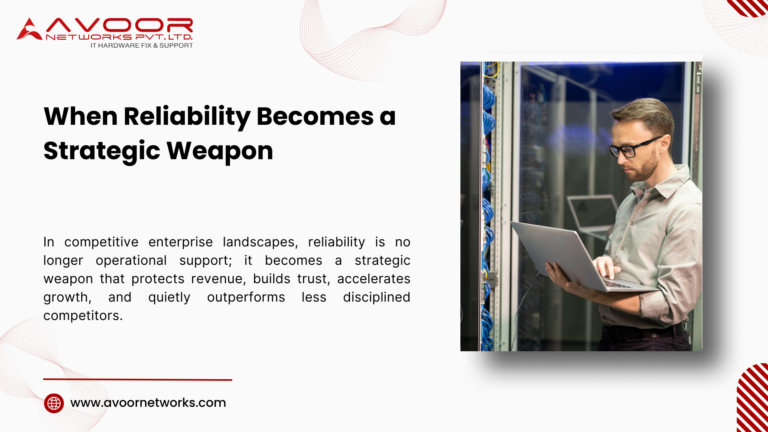
The organizations that understand this shift convert reliability into a strategic weapon.
1. Strategic Reliability Advantage Reduces Competitive Friction
Markets reward consistency.
Clients prefer partners who deliver uninterrupted service. Investors prefer predictable earnings. Regulators favor organizations with stable operations.
A strategic reliability advantage reduces friction across all these domains.
When systems operate predictably:
- Service-level commitments are met consistently
- Emergency remediation costs decline
- Brand reputation strengthens
- Operational volatility decreases
Competitors struggling with instability devote energy to crisis management. Reliable organizations devote energy to expansion.
Reliability eliminates distraction. That focus becomes strategic leverage.
2. Strategic Reliability Advantage Accelerates Decision Velocity
Strategic decisions depend on confidence in operational foundations.
Organizations lacking reliability hesitate to launch new services, expand into new markets, or integrate acquisitions. Leaders worry that infrastructure instability may undermine initiatives.
A strategic reliability advantage removes hesitation.
When leadership trusts operational resilience:
- Expansion timelines compress
- Integration efforts accelerate
- Innovation initiatives proceed without defensive buffers
Reliability becomes a multiplier of execution speed.
The organization that moves confidently often captures opportunity before competitors stabilize.
3. Strategic Reliability Advantage Enhances Financial Predictability
Instability produces financial volatility.
Unexpected outages generate emergency repair costs, contractual penalties, reputational damage, and recovery expenditures.
Organizations with a strategic reliability advantage experience controlled cost structures.
Preventive maintenance replaces emergency remediation. Lifecycle planning smooths capital expenditure cycles. Governance reduces compliance surprises.
Financial predictability strengthens investor confidence and strategic planning.
Reliability, in this context, becomes not merely operational discipline—but fiscal stability.
4. Strategic Reliability Advantage Strengthens Customer Trust
Trust compounds.
Customers rarely celebrate uninterrupted service—but they immediately notice disruption.
Organizations that consistently deliver reliability build silent credibility. Over time, this credibility becomes differentiating value.
A strategic reliability advantage:
- Reduces churn
- Increases long-term contract renewals
- Supports premium pricing
- Strengthens referral growth
While competitors repair damaged relationships after incidents, reliable organizations deepen loyalty.
Trust becomes defensible advantage.
5. Strategic Reliability Advantage Enables Controlled Innovation
Innovation introduces risk.
New technologies, digital transformation projects, and architectural shifts carry inherent uncertainty. Without stable foundations, innovation becomes destabilizing.
A strategic reliability advantage provides a stable base for experimentation.
When core systems are resilient:
- Change impact is isolated
- Rollback strategies are effective
- Performance baselines are clear
- Integration risk is minimized
Reliable organizations innovate safely.
Innovation supported by stability outperforms innovation built on fragile foundations.
6. Strategic Reliability Advantage Reduces Organizational Stress
Operational instability produces internal stress.
Frequent incidents lead to:
- Burnout
- Reactive decision-making
- Blame cycles
- Talent attrition
A strategic reliability advantage stabilizes organizational psychology.
Teams operate proactively rather than defensively. Leadership discussions shift from crisis management to strategic planning.
Lower stress improves retention, productivity, and collaboration.
Reliability protects culture as much as infrastructure.
7. Strategic Reliability Advantage Creates Long-Term Market Positioning
Over time, reliability compounds into brand identity.
Organizations known for operational stability attract:
- Enterprise clients with strict SLAs
- Strategic partnerships
- Regulatory trust
- High-value contracts
Competitors may match features or pricing, but they cannot easily replicate reputation.
A strategic reliability advantage becomes embedded in market perception.
When reliability is consistently demonstrated, it becomes part of the organization’s competitive DNA.
Reliability as Offensive Strategy, Not Defensive Insurance
Many organizations view reliability as insurance. Insurance protects against downside. It does not create upside.
However, a strategic reliability advantage transforms reliability into offensive capability.
Instead of merely avoiding failure, reliable organizations:
- Capture market share faster
- Execute transformation more confidently
- Maintain consistent service delivery
- Expand under pressure
Reliability shifts from cost center to growth enabler.
Building a Strategic Reliability Advantage
Developing a strategic reliability advantage requires disciplined investment:
- Proactive maintenance frameworks
- Continuous architectural reassessment
- Structured lifecycle governance
- Clear escalation models
- Comprehensive documentation discipline
- Independent review mechanisms
It also requires leadership alignment.
Reliability must be viewed as strategic infrastructure, not technical overhead.
Cultural Alignment and Strategic Reliability Advantage
Culture determines sustainability.
If reliability discipline is rewarded only during crises, it will erode during calm periods.
Organizations that embed reliability into performance metrics, executive evaluation, and operational culture sustain their advantage.
Cultural reinforcement ensures that governance intensity does not decline after incident-free quarters.
A strategic reliability advantage thrives in environments where discipline is permanent.
The Cost of Neglecting Strategic Reliability Advantage
Organizations that fail to develop reliability strategically often experience:
- Repeated service disruption
- Slower innovation cycles
- Financial unpredictability
- Reputation erosion
- Higher insurance and compliance costs
Short-term cost savings achieved by reducing maintenance or governance frequently produce long-term instability.
The absence of a strategic reliability advantage does not remain invisible. It becomes visible during competitive stress.
Enterprise Reliability Execution by Avoor Networks Pvt Ltd
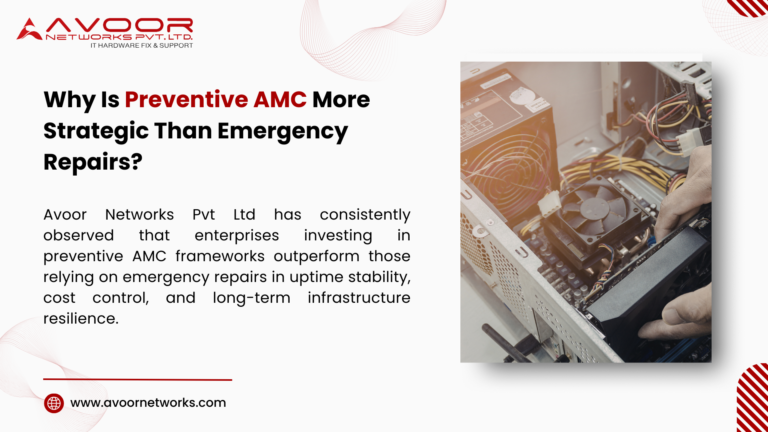
Avoor Networks Pvt Ltd supports enterprises in developing a strategic reliability advantage through disciplined lifecycle governance and proactive infrastructure management.
With over 26+ years of experience, the company delivers:
- Enterprise router, switch, and server support
- Preventive and corrective maintenance
- Chip-level hardware repair
- AMC and CAMC contracts
- End-of-life and EOSL support solutions
- Pan-India operational assistance
This structured approach transforms reliability from reactive maintenance into strategic leverage.
Conclusion
Strategic reliability advantage is not achieved by accident. It is built through disciplined governance, preventive investment, architectural humility, and cultural alignment.
When reliability matures into strategic capability, organizations gain speed, confidence, trust, and market strength.
Reliability is no longer defensive insurance. It becomes competitive weaponry.
Enterprises that recognize this transformation elevate reliability from technical requirement to strategic dominance.
In modern complex markets, reliability is not optional stability.
It is strategic power.