Introduction
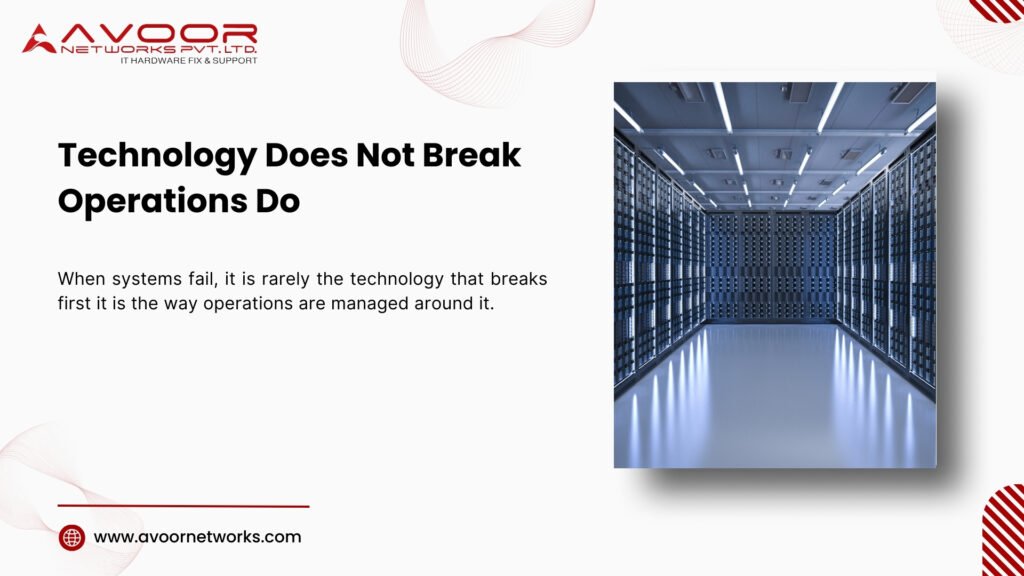
Technology decisions are often blamed on tools, platforms, or vendors when operations fail. Servers are labeled unreliable, networks are called unstable, and software is accused of being poorly designed. In reality, technology itself rarely breaks operations.
Operational failure almost always traces back to human decisions. Decisions made during planning, deployment, maintenance, and lifecycle management determine whether technology supports the business or becomes a liability.
Understanding how technology decisions shape operational outcomes is critical for enterprises that want stable, predictable IT environments.
1. Poor Planning at the Design Stage
Operational problems often begin at the design stage.
Early decisions such as:
- Underestimating workload growth
- Ignoring redundancy requirements
- Designing only for current needs
create fragile environments. When demand increases, systems fail not because of technology limitations, but because planning decisions failed to account for reality.
2. Choosing Technology Without Context
Selecting technology without understanding operational context is a common mistake.
This happens when:
- Tools are chosen based on features, not fit
- Vendor promises outweigh real requirements
- Complexity is added without need
Technology decisions made without considering skills, processes, and support models increase failure risk over time.
3. Ignoring Operational Reality
Operations expose weaknesses that design documents often miss.
Ignoring:
- Daily workload patterns
- Maintenance windows
- Environmental constraints
leads to instability. Technology does not fail on its own. It fails when decisions ignore how systems are actually used in production environments.
4. Delaying Maintenance and Support Decisions
Maintenance decisions are often postponed because systems appear stable.
This leads to:
- Accumulated wear
- Undetected early warning signs
- Increased failure probability
When failures occur years later, they are labeled “unexpected,” even though the cause was long-term neglect.
5. Treating Reliability as a One-Time Purchase
Many organizations believe reliability comes from buying better technology.
This mindset results in:
- Underinvestment in processes
- Lack of monitoring discipline
- Weak incident response
Reliability is not purchased. It is built through consistent operational decisions over time.
6. Allowing Technical Debt to Accumulate
Every shortcut creates technical debt.
Examples include:
- Skipping documentation
- Deferring upgrades without strategy
- Accepting recurring issues as normal
Over time, accumulated debt makes operations fragile. Technology decisions that ignore long-term impact eventually break operations.
7. Avoiding Accountability in Decision Making
When failures occur, blame is often shifted.
Without accountability:
- Root causes are not addressed
- The same mistakes repeat
- Operations remain unstable
Clear ownership of technology decisions ensures learning, improvement, and long-term operational resilience.
Turning Better Decisions Into Reliable Operations
Stable operations are not the result of perfect technology. They are the result of disciplined decision-making.
Enterprises that succeed:
- Plan realistically
- Align technology with operations
- Invest in maintenance and support
- Treat reliability as an ongoing discipline
These decisions, made consistently, prevent operational failure.
Enterprise Decision Support by Avoor Networks Pvt Ltd
Avoor Networks Pvt Ltd helps enterprises improve outcomes by guiding critical technology decisions throughout the infrastructure lifecycle.
With 26+ years of experience, the company provides:
- Enterprise router, switch, and server support
- Preventive and corrective maintenance
- Chip-level hardware repair
- AMC and CAMC services
- Support for EOL and EOSL infrastructure
- Pan-India on-site and remote assistance
This disciplined approach helps organizations turn better decisions into stable operations.
Conclusion
Technology does not break operations. Decisions do.
Every outage, failure, or disruption can be traced back to earlier choices about planning, deployment, maintenance, or support. Enterprises that recognize this shift their focus from blaming tools to improving decision-making.
By treating technology decisions as strategic responsibilities rather than technical tasks, organizations gain stability, predictability, and long-term operational success.
Reliable operations are not determined by technology alone but by the quality of decisions made over time. Small compromises in planning, maintenance, and support may seem harmless initially, yet they often grow into major operational failures later. Enterprises that focus on disciplined decision-making, long-term planning, and proactive support build stability and resilience that no tool or upgrade can replace.