Introduction
Operational reliability discipline is often misunderstood in enterprise IT. Many organizations treat reliability as a feature they can purchase with better hardware, newer software, or premium licenses. In reality, reliability is not something that comes bundled with technology.
True reliability is the outcome of consistent operational discipline. It is built through planning, execution, monitoring, and continuous improvement over time. Enterprises that understand this distinction experience fewer outages, predictable performance, and long-term infrastructure stability.
This article explains why reliability is an operating discipline and the critical steps enterprises must follow to achieve it.
1. Reliability Starts With Operational Mindset
The foundation of operational reliability discipline is mindset.
Organizations that achieve high reliability:
- Expect failures to happen
- Plan responses in advance
- Treat incidents as learning opportunities
When teams assume systems will “just work,” they are unprepared for disruptions. A reliability mindset accepts that failures are inevitable and focuses on reducing impact rather than denying risk.
2. Design Infrastructure for Failure, Not Perfection
Reliable systems are designed with failure in mind.
This includes:
- Redundancy in critical components
- Failover mechanisms
- Graceful degradation
Perfect systems do not exist. Infrastructure designed only for ideal conditions collapses under real-world stress. Operational reliability discipline demands architectures that absorb failures without widespread disruption.
3. Standardization and Process Consistency
Inconsistent processes undermine reliability.
Standardization improves reliability by:
- Reducing human error
- Simplifying troubleshooting
- Making outcomes predictable
When every deployment, configuration, and response follows a defined process, variability decreases. Consistency is one of the strongest contributors to operational reliability discipline in enterprise environments.
4. Preventive Maintenance as a Discipline
Preventive maintenance is not an optional activity. It is a core reliability discipline.
Effective preventive maintenance includes:
- Scheduled inspections
- Hardware health checks
- Cleaning and environmental reviews
- Firmware and configuration validation
Skipping maintenance may not cause immediate failure, but it steadily erodes reliability. Disciplined maintenance prevents small issues from becoming major outages.
5. Monitoring, Metrics, and Early Signals
Reliable operations depend on visibility.
Monitoring should focus on:
- Performance trends
- Error rates
- Temperature and power anomalies
- Early warning indicators
Operational reliability discipline requires teams to act on signals before users are impacted. Metrics are valuable only when they drive proactive response.
6. Controlled Change and Configuration Management
Uncontrolled change is one of the fastest ways to destroy reliability.
Reliable environments enforce:
- Change approval processes
- Configuration documentation
- Rollback plans
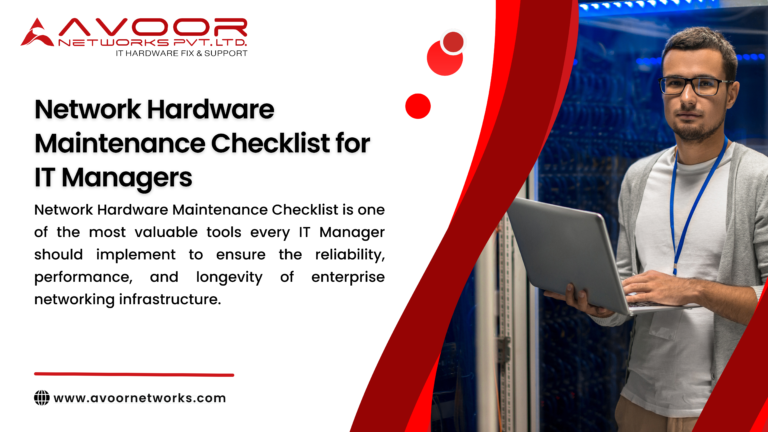
Frequent, unplanned changes introduce instability. Operational reliability discipline ensures that every change is intentional, tested, and reversible.
7. Professional Support and Lifecycle Governance
Reliability cannot be sustained without professional support and lifecycle oversight.
This includes:
- Structured support contracts
- Spare parts availability
- End-of-life risk management
- Planned upgrade cycles
Lifecycle governance ensures infrastructure evolves in a controlled manner rather than through emergency fixes.
Enterprise Reliability Support by Avoor Networks Pvt Ltd
Avoor Networks Pvt Ltd helps enterprises build and sustain operational reliability discipline across their IT infrastructure.
With 26+ years of experience, the company delivers:
- Enterprise router, switch, and server support
- Preventive and corrective maintenance
- Chip-level hardware repair
- AMC and CAMC services
- Support for EOL and EOSL equipment
- Pan-India on-site and remote assistance
This disciplined approach transforms reliability from a reactive goal into a repeatable an operating model.
Conclusion
Reliability is not a feature that can be purchased or enabled. It is the result of disciplined operations practiced consistently over time. So Reliability is important in IT
Enterprises that adopt an operational reliability discipline outperform those that rely on hardware upgrades alone. Through planning, standardization, preventive maintenance, controlled change, and professional support, reliability becomes predictable and sustainable.
In modern enterprise environments, reliability is not optional. It is an operating discipline that separates stable organizations from the constantly disrupted ones.