Introduction
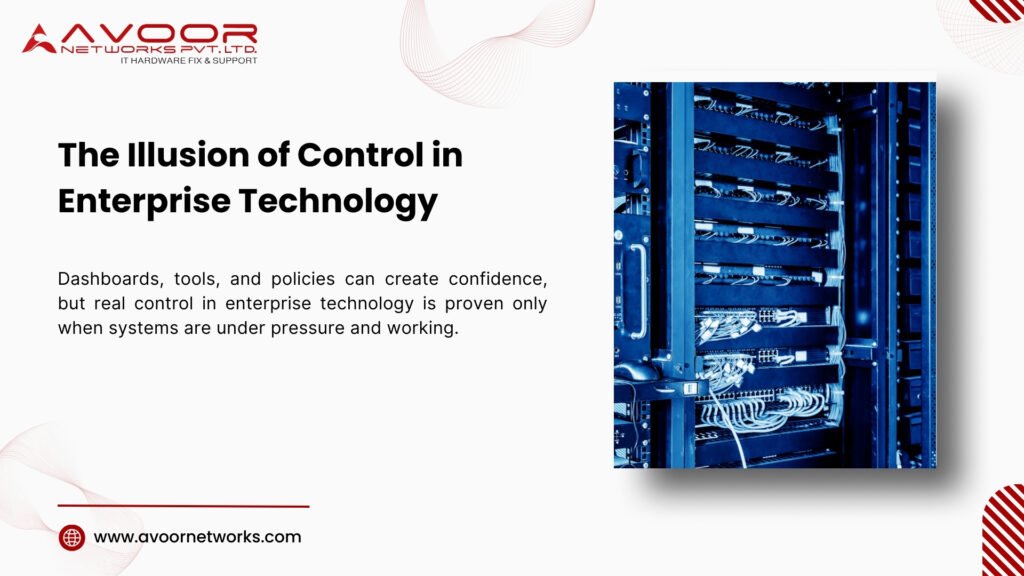
Enterprise technology control is often assumed to be a natural outcome of advanced tools, dashboards, automation platforms, and centralized management systems. When leaders can see metrics, configure policies, and trigger actions from a console, it feels like the environment is under control.
In reality, this sense of control is often an illusion. Many enterprise outages, failures, and disruptions occur in environments that appear highly controlled on paper. The problem is not lack of technology, but misplaced confidence in what technology alone can manage.
Understanding the illusion of control in enterprise technology helps organizations recognize why failures still happen despite heavy investment in tools and platforms.
1. Believing Visibility Equals Control
One of the most common illusions of enterprise technology control is equating visibility with control.
Dashboards provide:
- Performance metrics
- Status indicators
- Alerts and trends
However, visibility only shows what is happening, not whether the organization is prepared to respond. When teams believe that seeing an issue means controlling it, response gaps are ignored until failures escalate.
True control requires readiness, not just information.
2. Assuming Automation Eliminates Risk
Automation is often seen as a risk-removal mechanism.
While automation improves efficiency, it also:
- Scales mistakes quickly
- Hides underlying process gaps
- Reduces human awareness
When automation is implemented without operational discipline, failures occur faster and at a larger scale. Enterprise technology control becomes fragile when organizations rely on automation without understanding its limits.
3. Confusing Modern Tools With Stability
Modern platforms create a false sense of security.
Enterprises assume that:
- Newer tools are inherently stable
- Cloud or software-defined systems self-correct
- Complexity is handled by the platform
In reality, modern tools increase dependency on correct configuration, monitoring, and response. Without maturity, advanced technology increases instability rather than reducing it.
4. Trusting Dashboards Over Operational Reality
Dashboards often show what systems report, not what users experience.
This illusion appears when:
- Green indicators mask degraded performance
- Thresholds are poorly defined
- Alerts are ignored due to noise
Enterprise technology control fails when leaders trust dashboards more than operational feedback. Reality exists in user experience, not just metrics.
5. Ignoring Human and Process Dependency
Technology does not operate itself.
Enterprise environments still depend on:
- Skilled engineers
- Clear ownership
- Defined escalation paths
When organizations assume tools replace people and processes, control erodes. During incidents, unclear roles and weak processes cause delays even when technology is capable.
6. Assuming Vendor Guarantees Mean Reliability
Vendor assurances create another illusion of control.
Enterprises often believe:
- SLAs prevent outages
- Support contracts ensure fast recovery
- OEM responsibility equals reliability
In practice, recovery still depends on preparation, spares availability, and internal response capability. Vendor support complements control, but does not replace it.
7. Mistaking Compliance for Operational Control
Compliance creates structure, not reliability.
Being compliant means:
- Policies exist
- Audits are passed
- Documentation is complete
However, compliant environments still fail when procedures are not practiced or updated. Enterprise technology control collapses when compliance is mistaken for operational readiness.
Breaking the Illusion of Control
The illusion of control exists because technology makes environments appear manageable. True control is harder. It requires discipline, continuous attention, and honest assessment of readiness.
Enterprises that break this illusion focus on:
- Operational discipline
- Failure preparedness
- Human capability
- Lifecycle management
This shift replaces false certainty with real resilience.
Enterprise Control and Readiness Support by Avoor Networks Pvt Ltd
Avoor Networks Pvt Ltd helps enterprises move beyond the illusion of enterprise technology control by strengthening operational readiness and lifecycle discipline.
With 26+ years of experience, the company provides:
- Enterprise router, switch, and server support
- Preventive and corrective maintenance
- Chip-level hardware repair
- AMC and CAMC services
- Support for EOL and EOSL infrastructure
- Pan-India on-site and remote assistance
This approach transforms perceived control into real operational stability.
Conclusion
The illusion of control in enterprise technology is dangerous because it hides risk behind tools, dashboards, and automation. Control does not come from visibility alone, nor from modern platforms or vendor guarantees.
Real enterprise technology control is achieved through disciplined operations, skilled teams, realistic planning, and professional lifecycle support. Organizations that recognize this difference move from fragile confidence to genuine resilience.
In enterprise IT, control is not claimed. It is earned through consistent execution.