Introduction
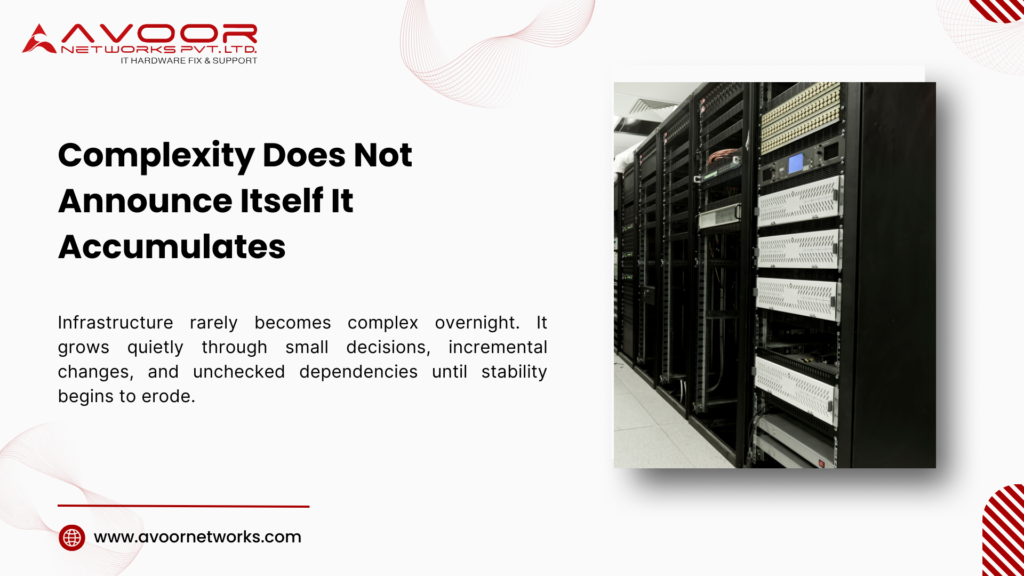
Infrastructure complexity rarely arrives dramatically. It does not trigger alarms or announce its presence during planning meetings. Instead, it accumulates quietly through incremental decisions, temporary fixes, overlapping tools, and undocumented changes.
Enterprise environments often appear stable while complexity grows beneath the surface. Systems continue to operate, dashboards remain green, and users may not immediately feel the strain. Yet over time, the hidden weight of complexity begins to reduce agility, slow recovery, and increase failure probability.
Understanding how infrastructure complexity accumulates is critical for organizations that want long-term operational strength rather than fragile stability.
1. Incremental Change Without Documentation
Small changes feel harmless.
A firewall rule adjustment here. A routing tweak there. A configuration change made during an incident. Individually, each modification solves an immediate problem. Collectively, undocumented changes create an opaque environment.
Over time:
- No one fully understands the system state
- Troubleshooting becomes guesswork
- Risk analysis becomes unreliable
Infrastructure complexity increases not because systems are advanced, but because their history becomes invisible.
2. Temporary Fixes Becoming Permanent
Emergency fixes are necessary during outages. The problem arises when temporary solutions remain in place indefinitely.
Examples include:
- Bypassed redundancy
- Hard-coded configurations
- Manual workarounds
These shortcuts are rarely revisited. Months later, they become part of production architecture. Infrastructure complexity grows because the environment reflects crisis decisions rather than deliberate design.
3. Tool Sprawl and Platform Overlap
Enterprises frequently adopt new tools to solve specific problems.
Over time, this leads to:
- Multiple monitoring platforms
- Overlapping security tools
- Redundant management systems
Each tool adds another layer of configuration, integration, and maintenance. Without consolidation discipline, infrastructure complexity multiplies faster than operational maturity.
More tools do not automatically equal better control. Often, they introduce fragmented visibility and competing processes.
4. Customization Without Standardization
Customization increases capability but also increases fragility.
When environments are heavily customized:
- Dependencies become tightly coupled
- Upgrades become risky
- Knowledge becomes specialized
Standardization provides predictability. Customization without governance increases infrastructure complexity to the point where small changes produce unpredictable consequences.
5. Unmanaged Technical Debt
Technical debt is one of the most powerful drivers of infrastructure complexity.
It accumulates when:
- Known issues are postponed
- Documentation is delayed
- Refactoring is ignored
- Upgrade paths are deferred
Debt does not create immediate failure. It creates long-term instability. As debt accumulates, environments become harder to maintain and more difficult to modernize.
6. Leadership Turnover and Knowledge Gaps
Infrastructure complexity also grows through organizational change.
When experienced personnel leave:
- Context is lost
- Informal knowledge disappears
- Historical decisions become unclear
Without structured documentation and governance, leadership transitions amplify complexity. New teams inherit systems they partially understand, increasing risk with every modification.
7. Scaling Without Architectural Discipline
Growth introduces new requirements.
However, scaling without revisiting architecture leads to:
- Layered integrations
- Compounding dependencies
- Performance bottlenecks
Infrastructure complexity increases when scaling decisions prioritize speed over coherence. What works at small scale often collapses under expansion without architectural review.
The Compounding Effect of Complexity
The most dangerous aspect of infrastructure complexity is that it compounds.
Each small decision adds friction:
- Recovery takes longer
- Testing becomes harder
- Documentation falls behind
- Confidence decreases
Eventually, complexity becomes the primary cause of instability—not hardware age or software flaws.
Organizations often respond by adding even more tools or redesigning entire systems. However, without governance discipline, complexity simply re-accumulates.
Managing Infrastructure Complexity Through Discipline
Reducing infrastructure complexity requires intentional effort.
Strong enterprises:
- Audit architectural sprawl
- Eliminate redundant tools
- Standardize configurations
- Track lifecycle maturity
- Document operational knowledge
Complexity does not disappear on its own. It must be managed continuously.Operational strength depends on limiting accumulation before it becomes unmanageable.
Enterprise Infrastructure Governance by Avoor Networks Pvt Ltd
Avoor Networks Pvt Ltd helps enterprises control infrastructure complexity through structured lifecycle management and disciplined support models.
With over 26+ years of experience, the company provides:
- Enterprise router, switch, and server maintenance
- Preventive and corrective support
- Chip-level repair services
- AMC and CAMC contracts
- EOL and EOSL infrastructure governance
- Pan-India technical assistance
This governance-driven approach ensures complexity is identified early and reduced before it impacts operations.
Conclusion
Infrastructure complexity does not announce itself because it grows gradually. It accumulates through minor compromises, urgent fixes, overlapping tools, and deferred decisions. By the time it becomes visible, operational agility has already declined.
Enterprises that proactively manage complexity through documentation, governance, and disciplined architecture maintain control over growth. Those that ignore it eventually experience fragility disguised as sophistication.
In enterprise IT, complexity is not created overnight. It is accumulated over years—and only deliberate discipline prevents it from overwhelming the organization