Introduction
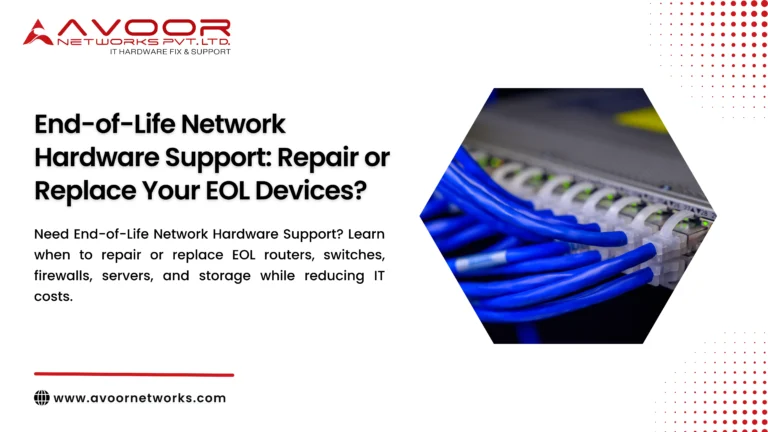
Enterprise network infrastructure is built to operate for years, but every router, switch, firewall, server, and storage system eventually reaches a stage where the original manufacturer reduces or discontinues official support. This is commonly known as End-of-Life or EOL.
Reaching EOL does not automatically mean that functioning network equipment must be immediately discarded. Many organizations continue operating legacy infrastructure because it remains stable, meets performance requirements, or supports applications that are expensive to migrate. The challenge is deciding whether repairing existing hardware or replacing it is the better business decision.
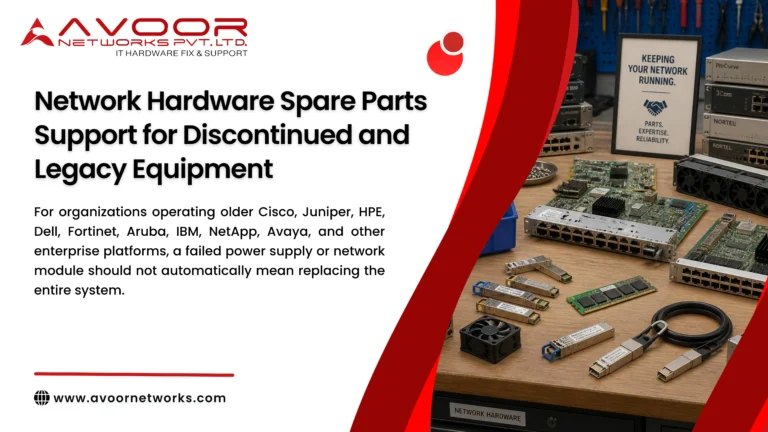
Professional end-of-life network hardware support can help businesses extend the useful life of selected EOL devices through component-level repair, preventive maintenance, spare-part support, and structured hardware testing.
At Avoor Networks Pvt. Ltd., our 26+ years of experience in enterprise network hardware repair enables us to support organizations managing legacy routers, switches, firewalls, servers, and storage equipment. This guide explains when repairing EOL equipment makes sense,end-of-life network hardware support when replacement should be prioritized, and how businesses can build a practical lifecycle strategy.
What Is End-of-Life Network Hardware?
End-of-Life network hardware generally refers to equipment that has reached a late stage in the manufacturer’s product lifecycle. Depending on the vendor, separate milestones may exist for end of sale, software maintenance, security support, spare availability, and technical support.
Common EOL equipment can include:
- Enterprise routers
- Network switches
- Firewalls
- Wireless controllers
- Servers
- Storage systems
- IP phones
- Network modules
- Power supplies
- Legacy data center hardware
It is important to check the specific lifecycle notice for the exact model rather than assuming that every older device has the same support status.
Why Businesses Continue Using EOL Network Equipment
Replacing a complete network infrastructure can require substantial capital expenditure, planning, testing, migration, and downtime.
Businesses may continue operating EOL devices because the equipment:
- Remains stable and reliable
- Meets current bandwidth requirements
- Supports legacy applications
- Is expensive to replace
- Requires complex migration
- Has readily repairable hardware
- Operates in a non-critical environment
In these situations, end-of-life network hardware support can provide additional time to plan a controlled migration rather than forcing an emergency replacement.
7 Critical Factors: Repair or Replace Your EOL Devices?
1. Evaluate the Hardware Condition
The first consideration should be the physical and operational condition of the equipment.
A repair may be practical when the problem involves:
- Failed power supplies
- Damaged capacitors
- Faulty MOSFETs
- Cooling fan failures
- Ethernet port faults
- PCB power circuit problems
If the device has multiple recurring faults or extensive board damage, replacement may be more economical.
2. Consider Security Support
Hardware functionality is only one part of the decision. A repaired device can operate correctly while its software platform may no longer receive appropriate security updates.
For internet-facing, security-sensitive, or regulated environments, organizations should carefully evaluate vendor security-support status before continuing to use an EOL device.
Repair can address hardware faults, but it cannot restore discontinued manufacturer software or security support.
3. Compare Repair and Replacement Costs
A complete enterprise switch, router, firewall, server, or storage end-of-life network hardware support controller can represent a significant investment.
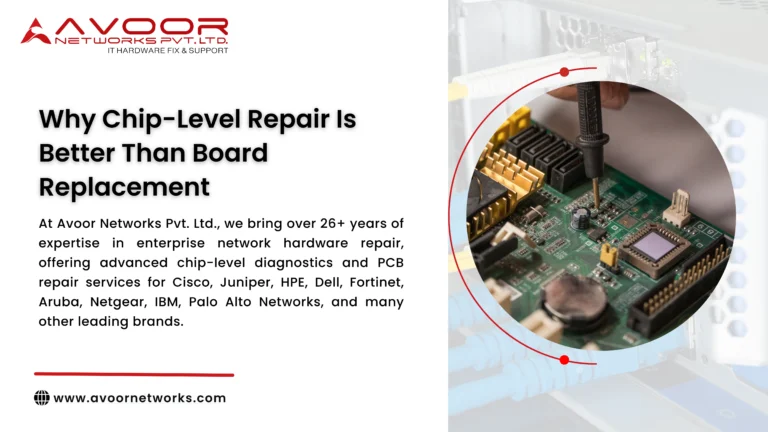
Chip-level repair targets the defective components rather than replacing the entire board or device.
This can reduce:
- Immediate hardware expenditure
- Procurement requirements
- Migration costs
- Installation effort
However, repair cost should be evaluated against the remaining useful life and business importance of the equipment.
4. Assess Spare-Part Availability
Replacement components become harder to source as products age.
Professional EOL support may include sourcing:
- Power supplies
- Cooling fans
- Interface modules
- Network cards
- Compatible electronic components
- Refurbished donor hardware
If reliable parts are no longer obtainable, migration to newer infrastructure becomes increasingly important.
5. Calculate the Cost of Downtime
A low-cost repair is not necessarily the best choice if repeated failures threaten a mission-critical network.
Organizations should consider:
- Revenue affected per hour of downtime
- Number of users dependent on the device
- Application criticality
- Availability of redundancy
- Recovery time
Critical infrastructure may justify proactive replacement even when repair remains technically possible.
6. Review Performance Requirements
Older equipment may still function perfectly but no longer meet modern business requirements.
Replacement should be considered when EOL hardware creates limitations involving:
- Network throughput
- Port density
- Power over Ethernet capacity
- Redundancy
- New connectivity standards
- Management capabilities
- Current security requirements
Repair restores existing functionality. It does not transform legacy equipment into a current-generation platform.
7. Consider a Phased Migration
The decision does not always need to be simply repair or replace.
Businesses can repair selected EOL equipment to maintain short-term operations while gradually migrating critical infrastructure.
A phased approach can provide:
- Controlled capital expenditure
- Reduced migration risk
- More testing time
- Better business continuity
- Planned rather than emergency upgrades
End-of-Life Network Hardware Support Through Chip-Level Repair
Chip-level repair is particularly valuable for discontinued equipment when complete replacement boards are expensive or difficult to source.
Professional PCB repair may address:
- No-power conditions
- Short circuits
- Voltage rail failures
- Burnt components
- Boot problems caused by hardware faults
- Ethernet interface failures
- PoE hardware faults
- Power supply failures
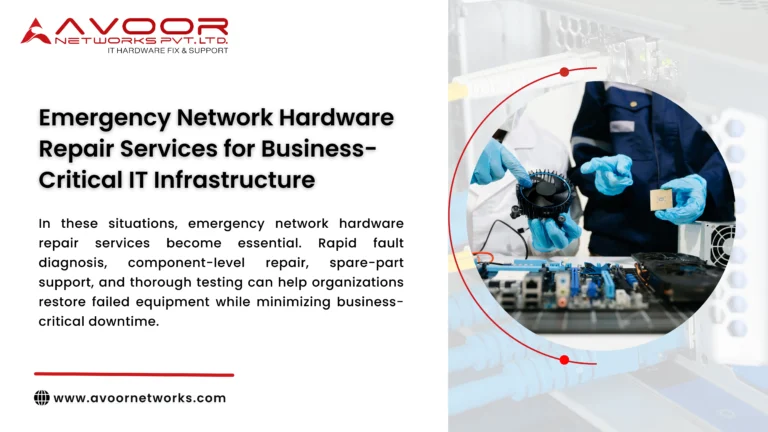
Engineers can diagnose the affected circuit and replace individual components such as ICs, MOSFETs, capacitors, regulators, and connectors.
This approach can extend the usable life of equipment that would otherwise be discarded.
Repair vs Replacement for EOL Network Hardware
| Factor | Repair EOL Hardware | Replace EOL Hardware |
|---|---|---|
| Initial Cost | Usually lower | Usually higher |
| Deployment Time | Can be faster | Migration may take longer |
| Existing Configuration | Generally retained | Reconfiguration may be required |
| Hardware Life | Extended | New lifecycle begins |
| Software Support | Does not restore vendor support | Current platforms generally offer active support |
| Migration | Can be postponed | Required |
| Best Use | Stable, repairable systems | Critical, obsolete, unsupported systems |
The correct decision should consider technical risk, security, cost, and business continuity together.
When Should You Repair EOL Network Hardware?
Repair may make sense when:
- The hardware fault is clearly identifiable.
- The equipment still meets business requirements.
- Compatible components are available.
- Replacement would create unnecessary disruption.
- The device is part of a legacy environment.
- A migration project is already planned.
- The system has adequate redundancy.
In these situations, professional end-of-life network hardware support can provide a cost-effective bridge between current operations and future upgrades.
When Should You Replace EOL Hardware?
Replacement should receive stronger consideration when:
- Security updates are no longer available.
- Hardware failures occur repeatedly.
- Performance no longer meets requirements.
- Critical spare parts are unavailable.
- Downtime risk is unacceptable.
- New applications require capabilities the device cannot provide.
- Compliance requirements demand a supported platform.
For mission-critical environments, business risk should take priority over short-term savings.
Why Choose Avoor Networks Pvt. Ltd.?
Avoor Networks Pvt. Ltd. provides enterprise network hardware repair and lifecycle support across India.
Our services include:
- EOL Network Hardware Repair
- Chip-Level PCB Repair
- Cisco Router Repair
- Cisco Switch Repair
- Firewall Repair
- Server Hardware Repair
- Storage Hardware Repair
- Power Supply Repair
- Legacy Spare-Part Support
- AMC and CAMC Services
- Refurbished Network Hardware
- Rental and Leasing Solutions
- PAN-India Pickup and Delivery
We support equipment from Cisco, Juniper, HPE, Dell, Fortinet, Aruba, Palo Alto Networks, Extreme Networks, NetApp, IBM, Avaya, Netgear, and other enterprise brands.
Our objective is not simply to repair a failed device. It is to help businesses determine whether continued repair, temporary lifecycle extension, or planned replacement offers the best operational value.
Conclusion
End-of-Life does not necessarily mean end of usefulness. Many enterprise routers, switches, firewalls, servers, and storage systems can continue providing reliable service when supported through professional diagnostics, preventive maintenance, spare-part management, and chip-level repair.
However, end-of-life network hardware support should be part of a broader lifecycle strategy. Hardware condition, cybersecurity support, spare availability, downtime risk, performance requirements, and migration costs must all be evaluated before deciding to repair or replace.
Avoor Networks Pvt. Ltd. helps organizations extend the life of suitable legacy hardware while preparing for controlled infrastructure upgrades. The right strategy can reduce unnecessary capital expenditure, prevent emergency replacements, and maintain network continuity without ignoring the risks associated with aging technology.