Introduction
Enterprise IT environments rarely depend on equipment from a single manufacturer. A typical organization may operate Cisco switches, Juniper routers, Fortinet firewalls, HPE servers, Dell infrastructure, Aruba wireless devices, Palo Alto Networks security appliances, and NetApp storage systems within the same network.
Managing such a diverse environment can become expensive when every brand requires a different service provider, support contract, repair process, and spare-parts strategy. This is where multi-brand network hardware repair provides significant value.
By working with one experienced repair partner capable of supporting multiple enterprise networking brands, organizations can simplify hardware maintenance, reduce repair and replacement expenses, extend equipment lifespan, and improve maintenance budget predictability.
At Avoor Networks Pvt Ltd, we provide multi-brand network hardware repair and maintenance for routers, switches, firewalls, servers, storage systems, IP phones, wireless equipment, and other enterprise IT hardware. With 26+ years of experience, our services include chip-level PCB repair, AMC and CAMC, legacy hardware support, refurbished equipment, rental solutions, and PAN-India pickup and delivery.
This guide explains how a multi-brand repair strategy can help enterprises reduce IT maintenance costs without compromising network reliability.
What Is Multi-Brand Network Hardware Repair?
Multi-brand network hardware repair is a centralized service approach where one technical service provider diagnoses, repairs, tests, and maintains networking equipment from multiple manufacturers.
Instead of coordinating separately with different service partners for every OEM, businesses can consolidate hardware support.
Equipment can include:
- Enterprise routers
- Network switches
- Firewalls
- Servers
- Storage systems
- Wireless controllers
- Access points
- IP phones
- Power supplies
- Network modules
- Interface cards
This approach is particularly useful for enterprises, system integrators, data centers, IT companies, healthcare organizations, BFSI environments, manufacturing companies, and government institutions operating heterogeneous infrastructure.
7 Proven Ways Multi-Brand Network Hardware Repair Reduces IT Costs
1. Reduces Dependence on Multiple Service Providers
Managing separate repair vendors for Cisco, Juniper, HPE, Dell, Fortinet, and other brands increases administrative complexity.
IT teams may need to manage different:
- Service agreements
- Escalation processes
- Repair procedures
- Turnaround expectations
- Billing systems
- Vendor contacts
A consolidated multi-brand network hardware repair strategy simplifies vendor management and reduces the administrative effort associated with hardware maintenance.
2. Avoids Unnecessary Hardware Replacement
When networking equipment fails, complete replacement is not always necessary.
Many faults originate from individual electronic components such as:
- MOSFETs
- Capacitors
- Voltage regulators
- Power management ICs
- PHY controllers
- Connectors
- Power circuits
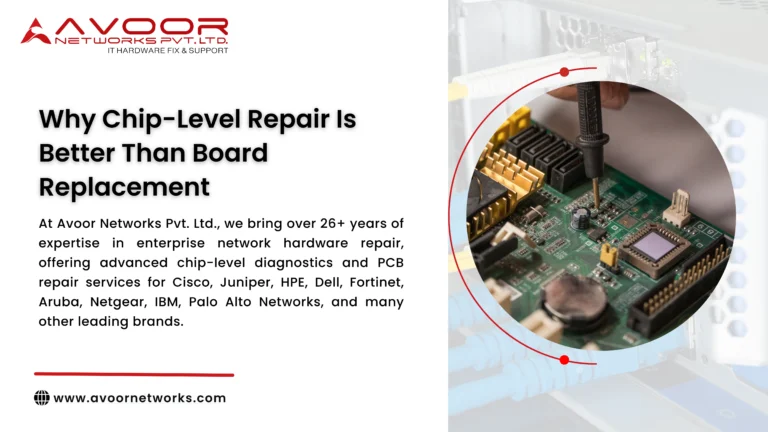
Chip-level diagnosis can identify the defective component and determine whether the original board can be repaired.
Repairing a component-level fault can be significantly more economical than replacing an entire switch, router, firewall, or motherboard.
3. Extends Enterprise Hardware Lifespan
Networking equipment represents a major capital investment.
Professional repair can extend the useful life of hardware affected by problems such as:
- Power supply failures
- Ethernet port failures
- Boot problems
- PoE faults
- Cooling system failures
- PCB faults
- Component degradation
Extending equipment lifespan allows businesses to delay unnecessary capital expenditure and maximize the value of existing IT assets.
4. Provides Better Support for EOL Equipment
Older networking equipment often becomes expensive to maintain once OEM lifecycle support ends.
Replacement parts may become difficult to source, while migrating to newer hardware may require additional investment in licenses, configuration, deployment, and testing.
Multi-brand hardware specialists can provide options such as:
- Chip-level PCB repair
- Compatible spare-part sourcing
- Power supply repair
- Refurbished replacement equipment
- Legacy hardware maintenance
This can help businesses maintain selected EOL devices while preparing for a planned infrastructure refresh.
Hardware repair, however, does not restore discontinued OEM software updates or security support. Security-critical EOL devices should be evaluated carefully.
5. Lowers Emergency Repair Expenses
Unexpected failures often cost more than scheduled maintenance.
Emergency incidents can involve:
- Expedited hardware procurement
- Unplanned technician costs
- Business downtime
- Replacement equipment
- Logistics expenses
A centralized repair partner familiar with an organization’s multi-brand infrastructure can simplify escalation and provide a more structured response.
This is especially valuable for businesses operating large networks across multiple locations.
6. Simplifies AMC and CAMC Management
Managing separate maintenance contracts for every hardware brand can make IT budgeting complicated.
A multi-brand AMC or CAMC strategy can consolidate eligible hardware into a more manageable maintenance framework.
Depending on the agreement, services may include:
- Preventive maintenance
- Hardware diagnostics
- Breakdown repair
- Spare-part coordination
- Service documentation
- Priority support
Consolidation can improve cost visibility and reduce administrative overhead.
7. Improves Maintenance Budget Predictability
Reactive maintenance makes IT expenditure difficult to forecast.
One month may involve minimal repairs, while the next may require multiple emergency replacements.
Structured multi-brand network hardware repair and maintenance programs help organizations plan for:
- Routine maintenance
- Hardware repairs
- Spare inventory
- Lifecycle extension
- Planned replacement
Better predictability allows IT departments to allocate budgets more effectively.
Multi-Brand Repair vs Multiple OEM Support Contracts
| Factor | Multi-Brand Repair Support | Separate OEM Support |
|---|---|---|
| Brands Covered | Multiple | Usually OEM-specific |
| Vendor Management | Centralized | Multiple vendors |
| PCB-Level Repair | Often available | Frequently replacement-focused |
| Legacy Hardware | Can support selected EOL models | Depends on OEM lifecycle |
| Cost Structure | Can be consolidated | Multiple contracts |
| Spare Strategy | Multi-brand | Vendor-specific |
| Administration | Simpler | More complex |
OEM support remains important where businesses require manufacturer software support, security updates, warranties, certifications, or vendor-specific escalation.
The right strategy can combine OEM support for critical current-generation systems with third-party hardware repair for suitable infrastructure.
Brands Commonly Supported Through Multi-Brand Repair
At Avoor Networks Pvt Ltd, enterprise hardware support includes equipment from brands such as:
Cisco
Routers, Catalyst switches, Nexus switches, firewalls, IP phones, wireless equipment, and UCS hardware.
Juniper
Routers, switches, security platforms, and related network hardware.
HPE and Aruba
Enterprise switches, servers, wireless devices, and network infrastructure.
Dell
Servers, switches, storage systems, and enterprise hardware.
Fortinet
FortiGate appliances and associated enterprise security hardware.
Palo Alto Networks
Enterprise firewall and security appliance hardware.
NetApp and IBM
Storage and enterprise infrastructure hardware.
Support availability should always be confirmed for the exact model, fault, and required spare components.
How Chip-Level Repair Further Reduces Maintenance Costs
Chip-level repair is one of the key advantages of specialized hardware maintenance.
Instead of automatically replacing a complete motherboard, engineers diagnose the affected PCB circuit.
Typical repair work may include:
- IC replacement
- MOSFET replacement
- Capacitor replacement
- Voltage regulator repair
- PCB trace restoration
- Connector replacement
- Power circuit repair
- Ethernet interface repair
This approach preserves functional parts of the original hardware and can reduce unnecessary replacement expenditure.
Reducing Spare Inventory Costs
Multi-brand maintenance can also improve spare-part planning.
Instead of purchasing excessive replacement hardware, organizations can identify genuinely critical components and maintain targeted spares such as:
- Power supplies
- Cooling fans
- Transceivers
- Interface modules
- Network cards
- Standby switches or routers
Repairable failed units can also be restored and retained as backup inventory where appropriate.
Preventive Maintenance Is Essential for Cost Reduction
Repair alone is not enough to control long-term IT maintenance costs.
Preventive maintenance helps identify problems before complete failure.
Routine activities can include:
- Hardware inspection
- Internal cleaning
- Cooling fan testing
- Power supply checks
- Interface testing
- Temperature monitoring
- Error-log review
- Physical connector inspection
Early fault detection reduces the likelihood of emergency failures and secondary PCB damage.
How Multi-Brand Support Benefits Large Enterprises
Organizations with hundreds or thousands of network assets can benefit particularly from consolidated support.
Potential advantages include:
- One escalation point
- Simplified vendor coordination
- Centralized repair tracking
- Consolidated service reporting
- Better spare-part planning
- Reduced administrative workload
- Easier maintenance budgeting
For organizations with offices or facilities across India, centralized multi-brand support can also simplify logistics and repair coordination.
Why Choose Avoor Networks Pvt Ltd?
Avoor Networks Pvt Ltd provides enterprise network hardware repair and maintenance services with 26+ years of industry experience.
Our capabilities include:
- Multi-Brand Network Hardware Repair
- Cisco Router and Switch Repair
- Juniper Hardware Repair
- HPE and Aruba Hardware Repair
- Dell Enterprise Hardware Repair
- Fortinet Firewall Repair
- Server and Storage Hardware Repair
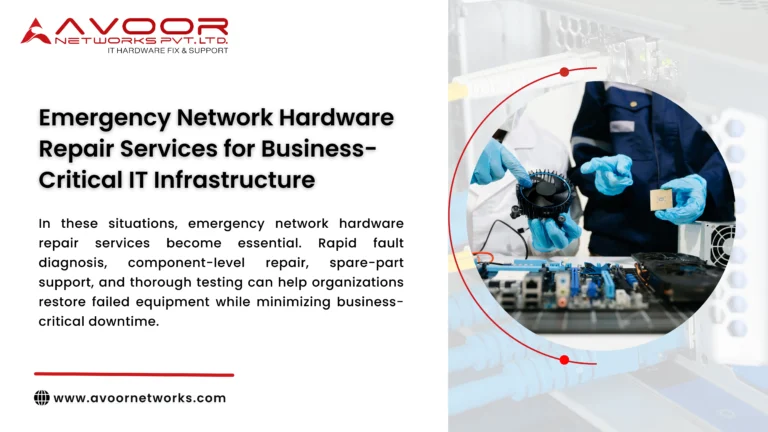
- Chip-Level PCB Repair
- Power Supply Repair
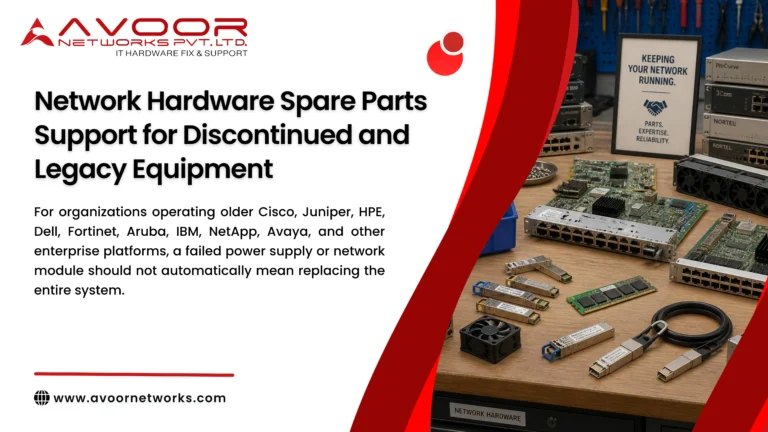
- Network Spare Parts Support
- EOL and Legacy Hardware Support
- AMC and CAMC Services
- Refurbished Hardware Sales
- Rental and Leasing Solutions
- PAN-India Pickup and Delivery
Our repair approach focuses on detailed fault diagnosis, component-level repair where technically appropriate, functional testing, and practical lifecycle support.
Conclusion
Enterprise networks are becoming increasingly diverse, and maintaining separate support arrangements for every hardware manufacturer can increase costs and administrative complexity.
Multi-brand network hardware repair gives organizations a more centralized approach to maintaining routers, switches, firewalls, servers, storage systems, and other enterprise infrastructure.
By combining component-level repair, preventive maintenance, legacy equipment support, targeted spare-part planning, and consolidated AMC/CAMC services, businesses can reduce unnecessary replacement expenses while extending the useful life of their hardware.
For enterprises seeking to simplify IT maintenance while controlling infrastructure costs, Avoor Networks Pvt Ltd provides multi-brand repair expertise designed to support reliable and cost-effective network operations.