Introduction
Enterprise networking equipment such as routers, switches, firewalls, servers, storage systems, and IP telephony devices represents a significant investment for businesses. When hardware fails, many organizations assume that replacing the entire circuit board or purchasing a new device is the only solution. In reality, many hardware failures are caused by a few defective electronic components that can be repaired without replacing the complete board.
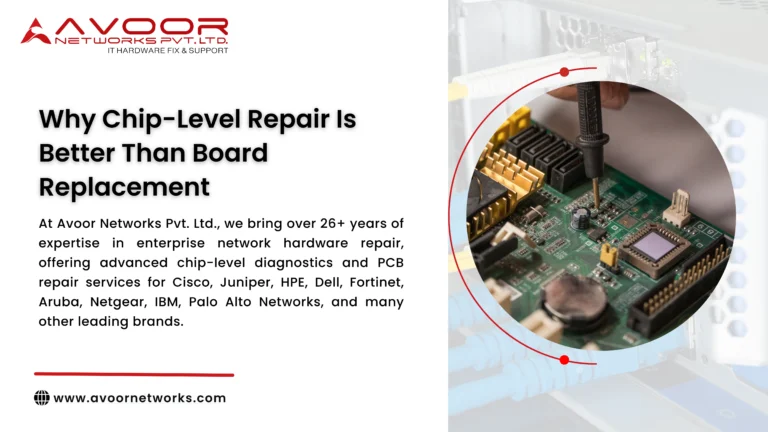
chip-level repair is better than board replacement. This is where chip-level repair provides a smarter, more cost-effective alternative. By diagnosing and replacing only the damaged electronic components, businesses can restore equipment to full functionality while reducing costs, minimizing downtime, and extending hardware lifespan.
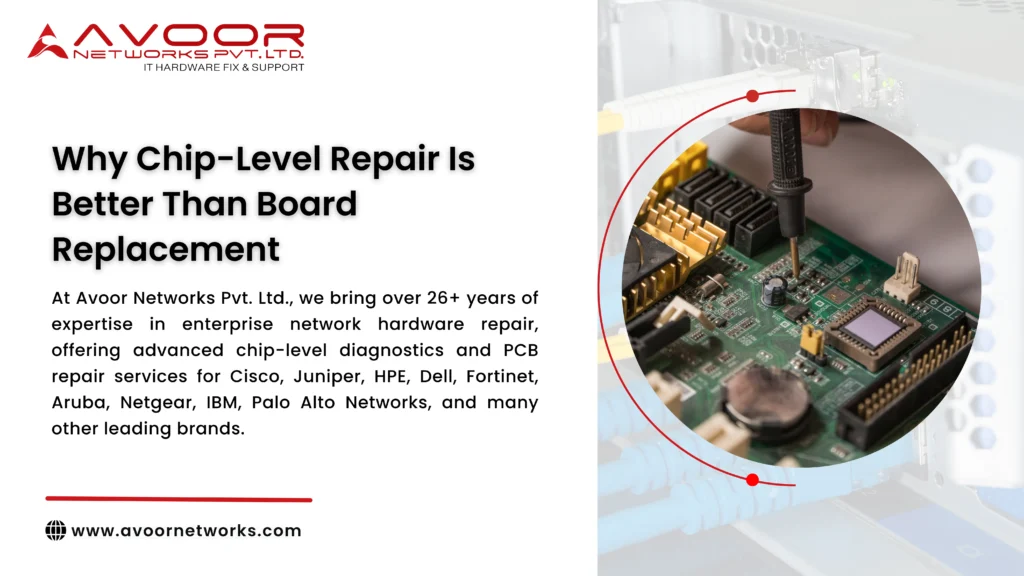
At Avoor Networks Pvt. Ltd., we bring over 26+ years of expertise in enterprise network hardware repair, offering advanced chip-level diagnostics and PCB repair services for Cisco, Juniper, HPE, Dell, Fortinet, Aruba, Netgear, IBM, Palo Alto Networks, and many other leading brands. This guide explains why chip-level repair is better than board replacement for enterprise networking equipment.
What Is Chip-Level Repair?
Chip-level repair is an advanced repair process that identifies and replaces only the faulty electronic components on a Printed Circuit Board (PCB) instead of replacing the entire board.
Common components repaired include:
- Integrated Circuits (ICs)
- MOSFETs
- Voltage Regulators
- Capacitors
- Resistors
- Inductors
- Ethernet Controller ICs
- Power Management ICs
- Memory Chips
- Connectors
Using specialized diagnostic equipment, engineers isolate the exact fault and restore the PCB to proper working condition.
What Is Board Replacement?
Board replacement involves removing the complete motherboard or PCB and installing a new or refurbished board, chip-level repair is better than board replacement.
While board replacement resolves hardware failures, it often results in:
- Higher repair costs
- Longer procurement times
- Limited spare availability
- Increased electronic waste
- Higher overall maintenance expenses
For many enterprise devices, replacement boards may no longer be available because the products have reached End of Sale (EOS) or End of Support (EoS).
Why Chip-Level Repair Is Better Than Board Replacement
1. Significant Cost Savings
One of the biggest advantages of chip-level repair is cost efficiency.
Instead of replacing an entire board, only defective components are repaired or replaced.
Benefits include:
- Lower repair costs
- Better return on investment
- Reduced capital expenditure
- Budget-friendly maintenance
This makes chip-level repair ideal for organizations managing large network infrastructures.chip-level repair is better than board replacement.
2. Faster Turnaround Time
Waiting for replacement boards can take days or even weeks.
Chip-level repair offers:
- Faster diagnostics
- Immediate component replacement
- Reduced procurement delays
- Quicker equipment restoration
This minimizes operational downtime and improves business continuity.
3. Extends Hardware Lifespan
Enterprise networking equipment is designed for long operational life.
Chip-level repair restores:
- Motherboards
- Switch PCBs
- Router boards
- Firewall electronics
- Server components
Extending hardware life delays expensive infrastructure upgrades.
4. Environmentally Friendly
Replacing complete boards generates unnecessary electronic waste.
Chip-level repair supports sustainability by:
- Reusing existing hardware
- Reducing e-waste
- Conserving raw materials
- Supporting environmentally responsible IT practices
It aligns with green IT initiatives adopted by many organizations.
5. Preserves Original Hardware
Board replacement may introduce compatibility issues if replacement boards differ in hardware revision or firmware.
Chip-level repair retains:
- Original PCB
- Factory configuration
- Hardware compatibility
- Existing licenses (where applicable)
This helps maintain system consistency and reduces configuration effort.
6. Ideal for End-of-Life (EOL) Equipment
Many enterprise devices remain operational long after manufacturers discontinue spare parts.
Chip-level repair provides a practical solution for:
- Cisco routers and switches
- Enterprise firewalls
- Storage controllers
- Server motherboards
- Legacy networking hardware
Organizations can continue using reliable equipment without sourcing discontinued boards.
7. Improves Return on Investment
Networking infrastructure is a long-term investment.
Chip-level repair helps organizations:
- Reduce replacement frequency
- Maximize equipment value
- Lower maintenance costs
- Improve asset utilization
This delivers greater long-term ROI.
Common Hardware Problems Resolved Through Chip-Level Repair
Professional chip-level repair can resolve:
- Power failures
- No power issues
- Boot failures
- Continuous rebooting
- Ethernet port failures
- Overheating
- Burnt components
- Short circuits
- Voltage instability
- Memory failures
- Power supply faults
- PoE controller failures
Accurate diagnostics ensure only the defective components are repaired.
The Chip-Level Repair Process
Professional repair typically includes:
Step 1 – Advanced Diagnostics
Engineers inspect:
- PCB condition
- Voltage rails
- Power circuits
- IC functionality
- Thermal performance
Step 2 – Fault Isolation
Specialized equipment identifies:
- Damaged ICs
- Burnt MOSFETs
- Failed capacitors
- Short circuits
- Open circuits
Step 3 – Component Replacement
Using precision soldering and BGA rework equipment, defective components are replaced with high-quality compatible parts.
Step 4 – Functional Testing
Every repaired device undergoes:
- Power testing
- Port testing
- Thermal testing
- Stress testing
- Burn-in testing
- Performance validation
Only after passing all quality checks is the equipment returned to service.
Chip-Level Repair vs Board Replacement
| Feature | Chip-Level Repair | Board Replacement |
|---|---|---|
| Cost | Lower | Higher |
| Turnaround Time | Faster | Slower |
| Electronic Waste | Minimal | Higher |
| Original Hardware | Preserved | Replaced |
| Equipment Lifespan | Extended | Depends on replacement |
| ROI | Higher | Lower |
| Availability | Suitable for EOL hardware | Limited by spare availability |
Why Choose Avoor Networks Pvt. Ltd.?
With over 26+ years of experience, Avoor Networks Pvt. Ltd. is a trusted provider of enterprise network hardware repair services across India.
Our expertise includes:
- Chip-Level PCB Repair
- Cisco Router Repair
- Cisco Switch Repair
- Firewall Repair Services
- Server Motherboard Repair
- Storage Hardware Repair
- Power Supply Repair
- Ethernet Port Repair
- Data Center Hardware Support
- AMC & CAMC Services
- Refurbished Network Hardware
- PAN India Pickup & Delivery
Our certified engineers use advanced diagnostic tools, precision soldering equipment, and OEM-grade repair procedures to restore enterprise networking hardware efficiently and reliably.
Conclusion
Choosing chip-level repair over complete board replacement is a cost-effective, sustainable, and technically sound approach for maintaining enterprise networking equipment. By repairing only the faulty components, businesses can significantly reduce repair expenses, minimize downtime, extend equipment lifespan, and maximize the value of their IT investments.
Whether your organization operates Cisco switches, enterprise routers, firewalls, or server infrastructure, professional chip-level repair offers an efficient alternative to costly replacements.
Partner with Avoor Networks Pvt. Ltd. for expert chip-level repair solutions that keep your enterprise network running reliably while reducing operational costs.