Introduction
Enterprise networks often depend on hardware that remains operational long after manufacturers stop selling or actively supporting specific models. Routers, switches, firewalls, servers, storage systems, power supplies, interface modules, and other components can continue performing reliably for years, but maintaining them becomes increasingly difficult when original spare parts are no longer readily available.
This is where network hardware spare parts support becomes essential. Reliable access to compatible replacement components can help businesses maintain discontinued and legacy equipment, reduce unnecessary capital expenditure, and avoid emergency infrastructure migrations.
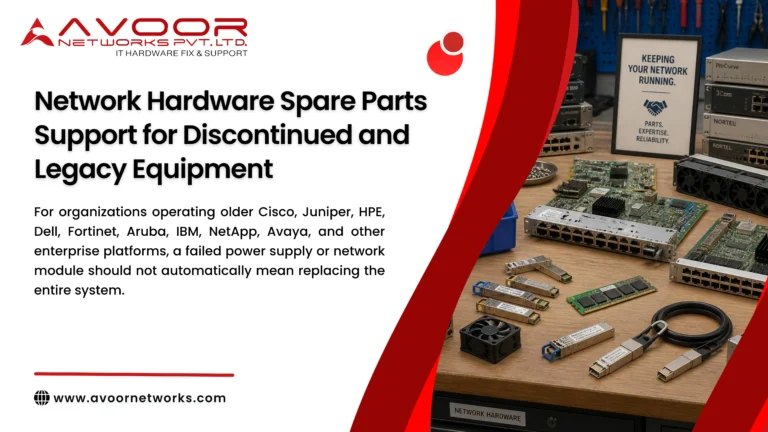
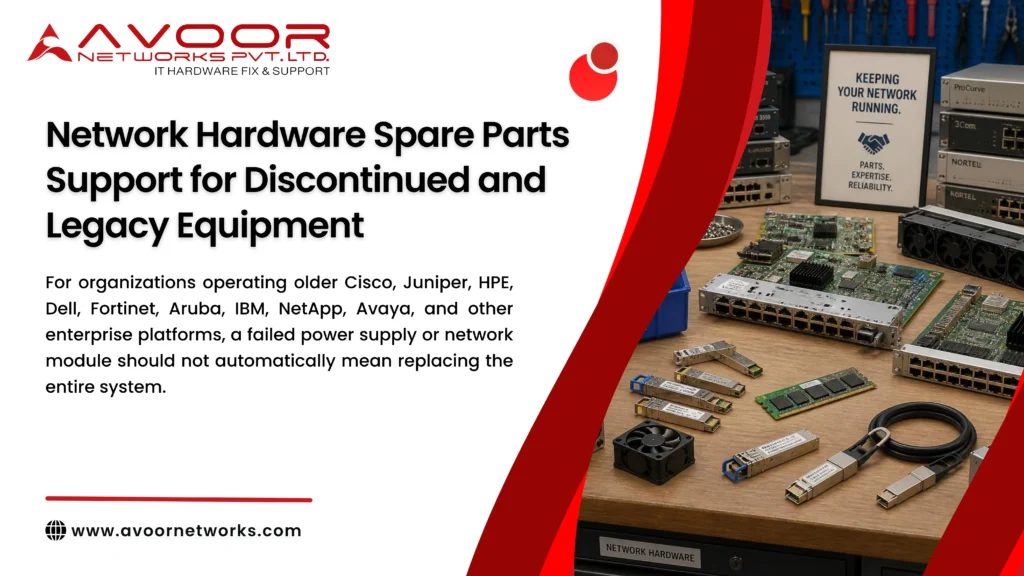
For organizations operating older Cisco, Juniper, HPE, Dell, Fortinet, Aruba, IBM, NetApp, Avaya, and other enterprise platforms, a failed power supply or network module should not automatically mean replacing the entire system.
At Avoor Networks Pvt Ltd, we provide multi-brand enterprise network hardware repair, chip-level PCB repair, legacy spare sourcing, refurbished hardware, AMC and CAMC support, and PAN-India pickup and delivery. This guide explains how spare parts support helps organizations maintain discontinued network equipment while planning a controlled long-term lifecycle strategy.
What Is Network Hardware Spare Parts Support?
Network hardware spare parts support involves identifying, sourcing, testing, repairing, and supplying compatible replacement components for enterprise networking equipment.
Depending on the equipment and availability, spare parts can include:
- Power supply units
- Cooling fans
- Network interface modules
- Line cards
- Supervisor modules
- Transceivers
- Network adapters
- Server components
- Storage controllers
- Connectors
- PCB components
- Memory and storage modules
- Chassis components
For discontinued products, spare-part support can become particularly important because normal OEM procurement channels may become limited over time.
Why Legacy Network Equipment Still Matters
Not every older device needs immediate replacement.
Many businesses continue operating legacy equipment because it:
- Meets current performance requirements
- Supports specialized applications
- Remains technically stable
- Is integrated with existing infrastructure
- Would be expensive to migrate
- Operates in a non-critical environment
- Is maintained as backup infrastructure
Replacing functioning equipment purely because of its age may create unnecessary capital expenditure.
However, organizations should evaluate hardware support alongside software lifecycle, security updates, performance requirements, and business risk.
7 Critical Benefits of Network Hardware Spare Parts Support
1. Extends the Useful Life of Legacy Equipment
Availability of suitable replacement parts allows organizations to continue operating hardware that remains technically fit for purpose.
Instead of replacing an entire switch because of a failed PSU, for example, replacing the defective power supply may restore normal operation.
This helps maximize the useful life of existing IT assets.
2. Reduces Emergency Replacement Costs
Unexpected failure of discontinued hardware can create significant financial pressure.
Without spare-part availability, businesses may be forced to purchase a new platform immediately.
That can involve costs for:
- New equipment
- Licensing
- Configuration
- Installation
- Migration
- Testing
- Staff resources
Reliable network hardware spare parts support gives IT teams additional recovery options.
3. Minimizes Network Downtime
A small hardware component can bring an entire device offline.
Common examples include:
- Failed PSU
- Damaged fan
- Interface module failure
- Network port module fault
- Storage controller failure
Keeping critical spare parts available can significantly reduce the time required to restore infrastructure.
4. Supports End-of-Life Network Hardware
When manufacturers announce End-of-Sale or other lifecycle milestones, spare availability may eventually become limited.
Third-party hardware specialists can help organizations maintain selected legacy systems by providing compatible or refurbished spare components where appropriate.
This can be particularly valuable during a planned migration period.
5. Reduces Electronic Waste
Replacing an entire device because one replaceable component has failed creates unnecessary electronic waste.
Extending hardware life through repair and spare-part replacement can:
- Reduce discarded equipment
- Improve asset utilization
- Lower replacement frequency
- Support sustainable IT practices
Repair and reuse should still be balanced against energy efficiency, security, and reliability requirements.
6. Supports Business Continuity
Critical infrastructure should not depend on a single unavailable spare.
Businesses can identify high-risk components and maintain suitable standby inventory for equipment such as:
- Core switches
- Enterprise routers
- Firewalls
- Servers
- Storage platforms
Having tested spares available can shorten recovery time during unexpected hardware incidents.
7. Creates Time for Planned Infrastructure Migration
Legacy hardware support should not always be viewed as a permanent solution.
In many cases, spare-part support provides a valuable bridge between an unexpected failure and a planned technology refresh.
Organizations gain additional time to:
- Evaluate replacement platforms
- Approve budgets
- Test configurations
- Plan migration windows
- Train IT teams
- Reduce implementation risks
This is considerably safer than performing an emergency migration after a critical hardware failure.
Common Spare Parts for Discontinued Network Equipment
Router Spare Parts
Frequently required router components can include:
- Power supplies
- Network modules
- Interface cards
- Cooling fans
- Memory modules
- Internal electronic components
Availability varies considerably by model and lifecycle stage.
Switch Spare Parts
Enterprise switches may require:
- PSUs
- Fan modules
- Supervisor modules
- Line cards
- Uplink modules
- Transceivers
- PoE-related components
Modular switches can particularly benefit from planned spare inventory.
Firewall Spare Parts
Depending on the platform, support may involve:
- Power supplies
- Cooling fans
- Storage components
- Interface modules
- Internal PCB components
Security appliances require additional caution because hardware repair does not restore discontinued security updates or vendor software support.
Server and Storage Spare Parts
Legacy server and storage environments may require:
- Power supplies
- RAID controllers
- Storage controllers
- Network adapters
- Fans
- Memory
- Backplanes
- Motherboard components
Maintaining critical spares can reduce downtime for older production environments.
Spare-Part Replacement vs Chip-Level Repair
Not every hardware failure requires a complete spare module.
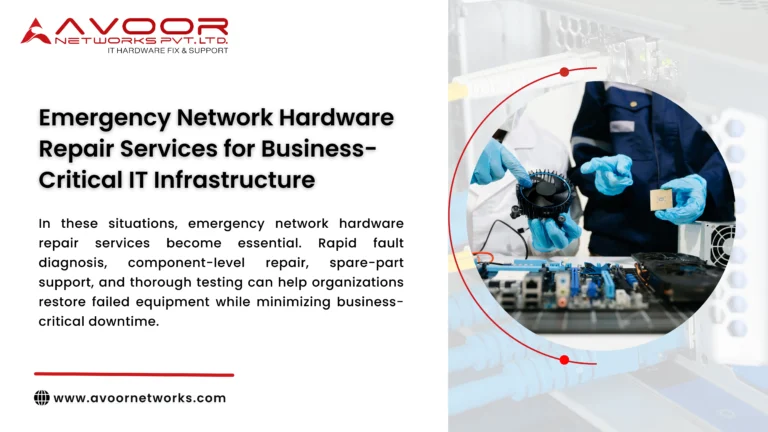
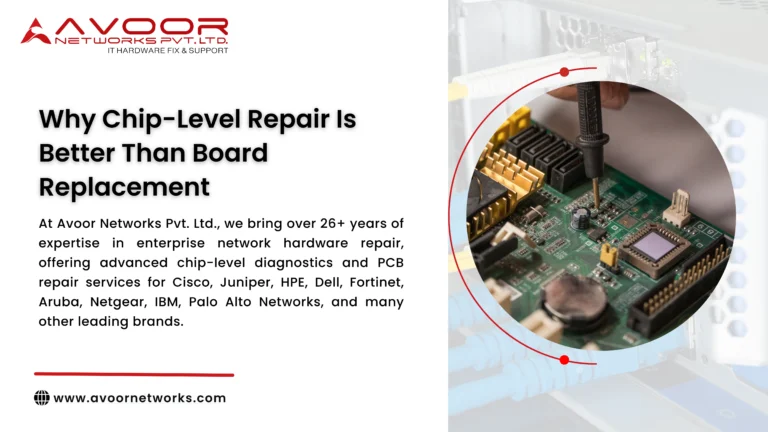
If a replacement board or module is unavailable, chip-level PCB repair may provide another option.
Component-level repair can address faults involving:
- ICs
- MOSFETs
- Capacitors
- Voltage regulators
- Power circuits
- Connectors
- Ethernet controller circuits
- PCB tracks
This makes chip-level repair particularly useful for discontinued equipment where complete boards are difficult or expensive to source.
| Factor | Spare-Part Replacement | Chip-Level Repair |
|---|---|---|
| Approach | Replace module/component | Repair faulty PCB circuit |
| Turnaround | Depends on availability | Depends on fault complexity |
| EOL Hardware | Limited by spare stock | Useful for repairable boards |
| Cost | Varies by component | Can be more economical |
| Original Board | May be replaced | Usually retained |
| Best Use | Available tested spare | Component-level PCB fault |
A professional diagnosis should determine which approach offers the best balance of reliability, cost, and recovery time.
How to Build a Legacy Hardware Spare Strategy
Businesses operating discontinued infrastructure should maintain a structured spare-part plan.
Start by identifying critical hardware and documenting:
- Manufacturer
- Model number
- Serial information
- Hardware revision
- Installed modules
- Power supply type
- Firmware/software version
- Current lifecycle status
- Available redundancy
Next, identify which components would cause the greatest operational impact if they failed.
High-priority spare inventory may include power supplies, fan modules, interface modules, transceivers, and complete standby units for particularly critical systems.
All stored spares should also be periodically tested. A spare that has remained unused for years should not automatically be assumed to be production-ready.
When Should Legacy Hardware Be Replaced Instead?
Spare-part support can extend equipment life, but it should not delay necessary modernization indefinitely.
Replacement should be considered when:
- Hardware failures become frequent
- Reliable spares become unavailable
- Performance no longer meets requirements
- Energy consumption becomes inefficient
- Business requirements exceed hardware capability
- Vendor security updates have ended
- Compliance requires a supported platform
- Downtime risk becomes unacceptable
Hardware repair solves hardware problems. It cannot restore discontinued OEM software, licensing, security patches, or manufacturer support.
For critical environments, these factors should be included in every repair-versus-replace decision.
Why Choose Avoor Networks Pvt Ltd?
Avoor Networks Pvt Ltd provides enterprise hardware lifecycle support for businesses operating both current and legacy network infrastructure.
Our capabilities include:
- Network Hardware Spare Parts Support
- Legacy and EOL Hardware Support
- Cisco Router and Switch Repair
- Firewall Repair
- Server Hardware Repair
- Storage Hardware Repair
- Chip-Level PCB Repair
- Power Supply Repair
- Refurbished Network Equipment
- AMC and CAMC Services
- Rental and Leasing Solutions
- PAN-India Pickup and Delivery
We support multiple enterprise brands, including Cisco, Juniper, HPE, Dell, Fortinet, Aruba, Palo Alto Networks, Extreme Networks, NetApp, IBM, Avaya, and Netgear.
Our objective is to help organizations maintain critical infrastructure economically while providing practical options for repair, spare replacement, and planned hardware migration.
Conclusion
Discontinued hardware creates a unique challenge for enterprise IT teams. Equipment may remain perfectly capable of supporting business operations while replacement components become increasingly difficult to obtain.
Professional network hardware spare parts support helps bridge this gap by providing access to suitable replacement components, refurbished hardware, component-level repair, and legacy equipment expertise.
A well-planned spare strategy can reduce downtime, control maintenance expenses, extend equipment life, and prevent emergency migrations. However, legacy hardware should also be continuously evaluated for security, performance, reliability, and business risk.
With Avoor Networks Pvt Ltd, organizations can combine spare-part support, chip-level repair, preventive maintenance, and lifecycle planning to keep critical enterprise infrastructure operational while preparing for future upgrades.